I grew up in a time, and I think many of us have, when we got ready for our school science fair every year. We would each come up with an hypothesis. We would employ the scientific method, create our tri-fold poster, and present. Job well done. But what about if we challenged the traditional science fair hypothesis tradition, and embraced instead what Matt Bobrowsky argues, that “science projects are more authentic with no ‘hypothesis’” (Bobrowsky, 2015)? I wonder how I can foster a love of learning and questioning without buying in to the old traditional ways of “doing the science fair”?
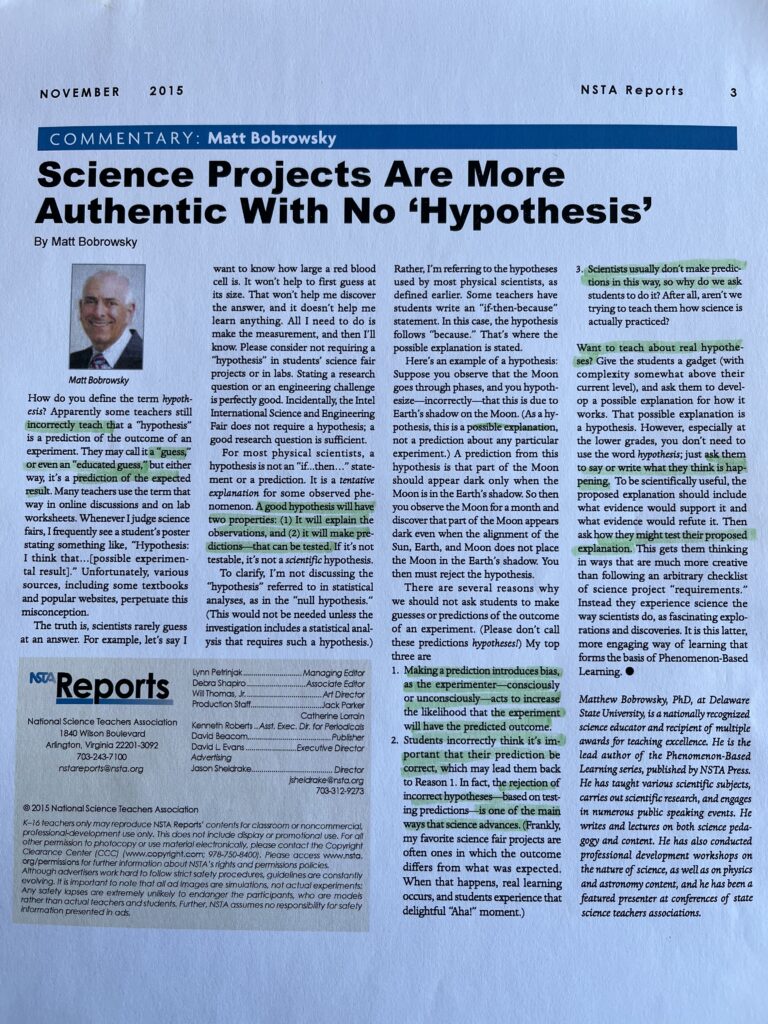
One way is to use the POE method: Predict, Observe, Explain. In this method students do not skew their results to fit what their hypothesis is, and engage in real learning to explain what they observe. This becomes a celebration of learning instead of a box to tick.
I wonder if this kind engagement will really prepare our students for the future and inspire new discovery.
I wonder how I might adapt the POE method for the early years and the intermediate-to-middle school years.