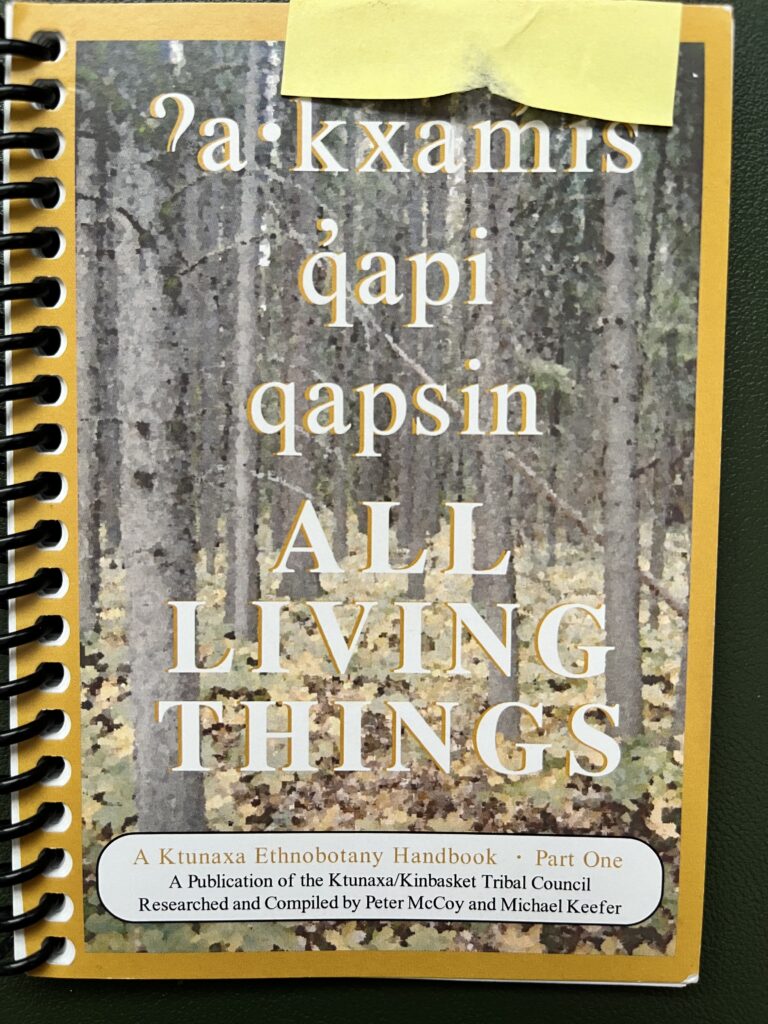
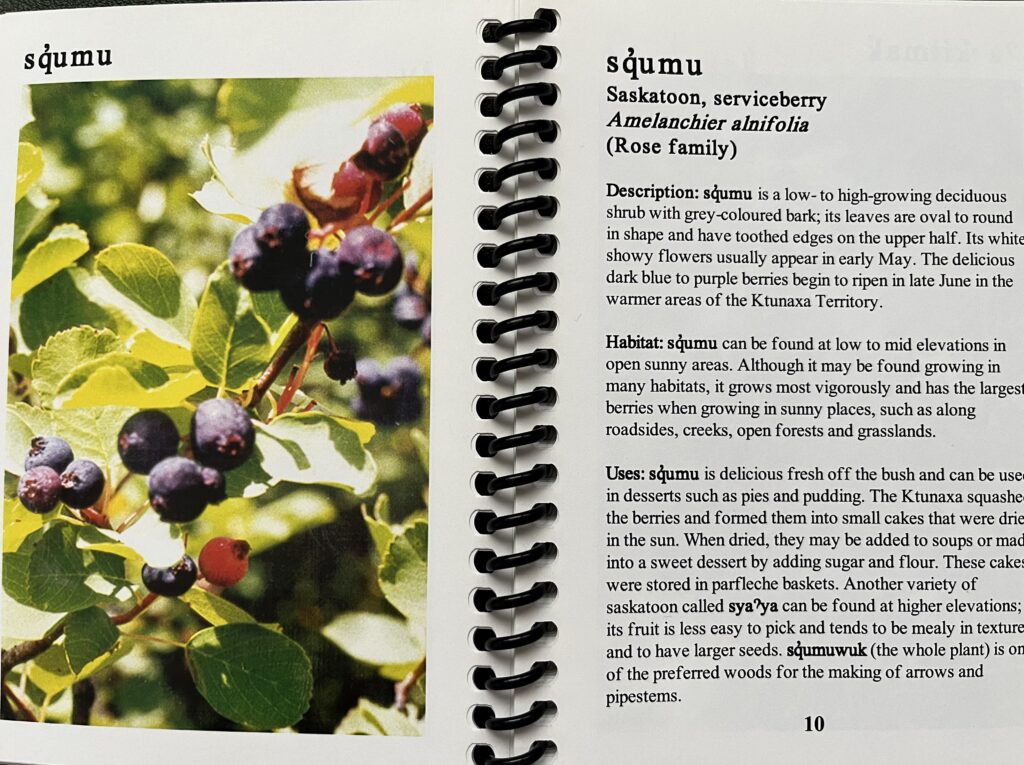
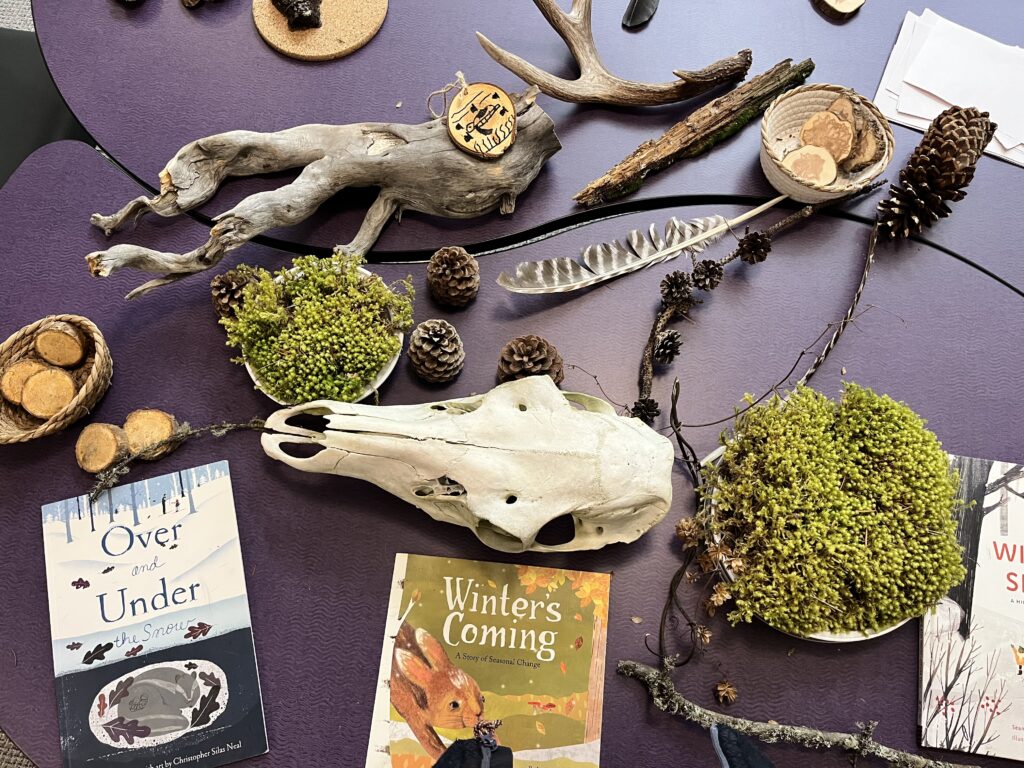
Place based learning offers a beautiful way to create meaningful connections to land on which we live. I was recently lent “All Living Things” which was researched and compiled by Peter McCoy and Micheal Keefer, and published by the Ktunaxa/Kinbasket Tribal Council.
With this little book in hand I am able to begin my attempt at teaching a love of our loca area slowly and deeply, and with intention. I am very thankful to the lender who has proven to be a deep well of knowledge and support.
Collaboration makes us all better at what we do, and I am thankful to have learned this important lesson. This is another way to make meaningful connections.
I am left wondering if I will be able to communicate me deep love of this content to my students, or if they will think my zeal is cheesy or boring. I guess I will find out!
As a future teacher of elementary science I really believe that we have to actively teach our students what reciprocity looks like, and create meaningful ways for them to participate in reciprocity.
A few examples I have are: – Planting a class garden – Watering the ground if we take a plant for our own use – Safely picking up garbage when we are outside (and inside for that matter) – Setting clear expectations for how we treat the outdoor spaces we occupy
I wonder what else I could add to this ongoing list?
Respect has become a core part of my teaching philosophy.
As scientists we must have:
Respect for the people who have come before us, and on whose shoulders we stand.
Respect for the knowledge other people hold.
Respect for the animals and other living things.
Respect for the Planet.
We have had to consider what our future classroom will look like, and the reality is that we have to model respect if we expect to see it grow while our students are under our care.
I would say the most profound realization that I have had this semester is that I am not alone in teaching the students that pass through my classroom. I alone do not need to teach them everything there is to know about any given topic.
For example, I chose to plan a unit about biomes. I started researching all the biomes on Earth. I was sucked into the vortex of the various subcategories. There was so much information and so many different avenues I could take to show my students the wide world. I was pumped. I made plans to do ‘reading comprehension’ sheets and have my students learn so many cool facts.
But then I got some perfectly timed advice.
Why not do less, but do it deeper. Allow space and time to really explore a few biomes and make it meaningful.
I felt a huge weight lift off my shoulders, and I realized. I alone do not need to teach my students everything there is to know about this beautiful Earth we get to call home. I do not need to stress about teaching them everything about every topic.
We have spent a lot of time talking about inquiry based learning in the UVic teacher education program. Student engagement is really high which means they are learning a lot. I also love that it gives students the opportunity to try something out, have it fail, and try another way. I see how inquiry based learning is applicable across the curriculum, not just in science and math. For example I created an activity for an English Language Arts lesson that uses art and drama to engage with this Ktunaxa Legend.
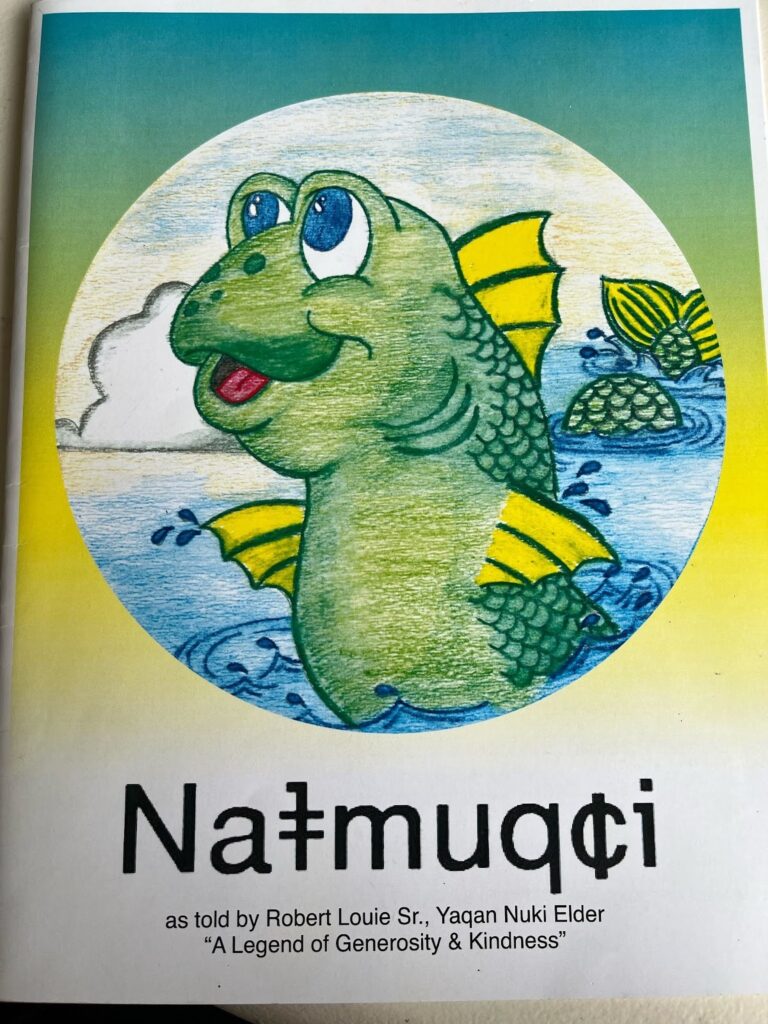
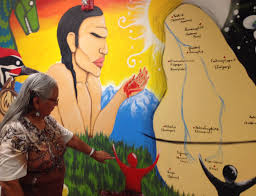
Nalmuqci as told by Robert Louie Sr.
Book Summary: Nalmuqci is a kind water creature who is given a “special” task, to prepare the land for the Ktunaxa people. A group of animals, Muskrat and the Woodpecker family, are jealous of Nalmuqci. Skinkuc, the coyote, convinces the gang of animals to chase Nalmuqci. The book is about the journey that follows.
Curricular Content/Competencies:
ELA:Explore oral storytelling processes as a way to understand the relationship between reading, writing, and oral language.
Art: Explore artistic expressions of themselves and community through creative processes of creating art collectively.
Book Activity: Story drama with a class made map on the ground. Clear the desks to one side of the classroom. Lay down three pieces of white paper from the giant rolls, each piece should be about 3 meters long. Spend the morning looking at the map in the back of the book and allowing the students to recreate it on the floor map. Then, in the afternoon the students will be split into 3 groups: one group is Nalmuci, one group is the woodpecker gang, and one group is Skinkuc (coyote). Each group will decide on three actions that describe what they will do when the drum sounds. Now form groups of three students (one from each animal group). Move around the map and at the sound of the drum do one of the actions.
For a science application you try the following activity:
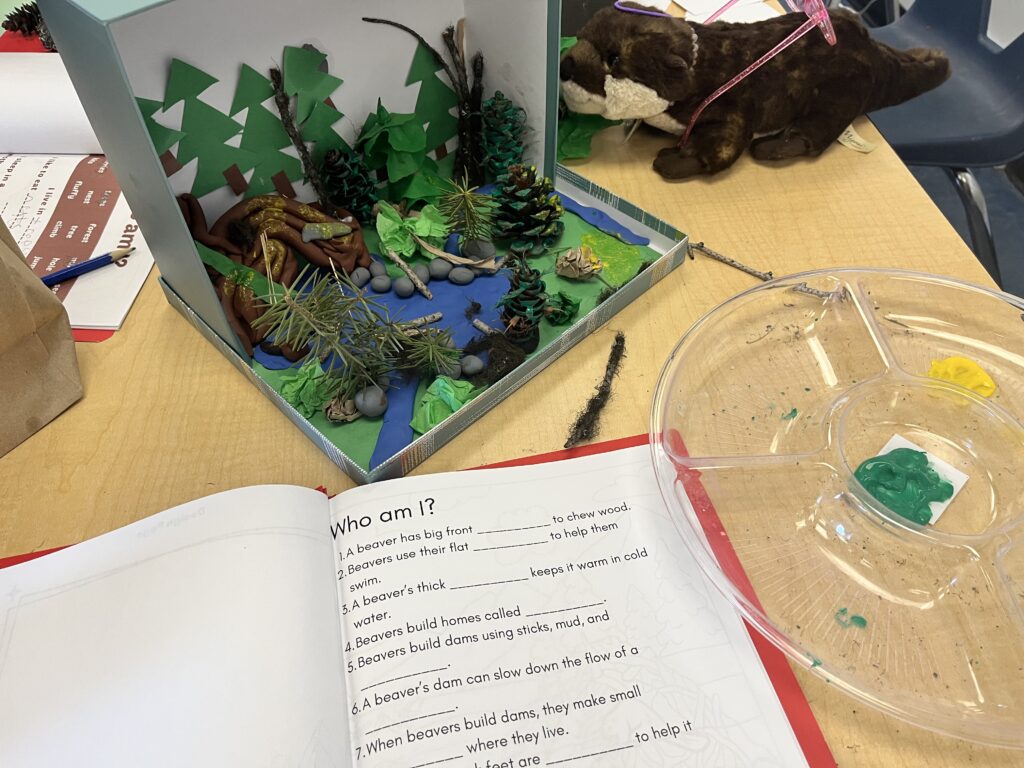
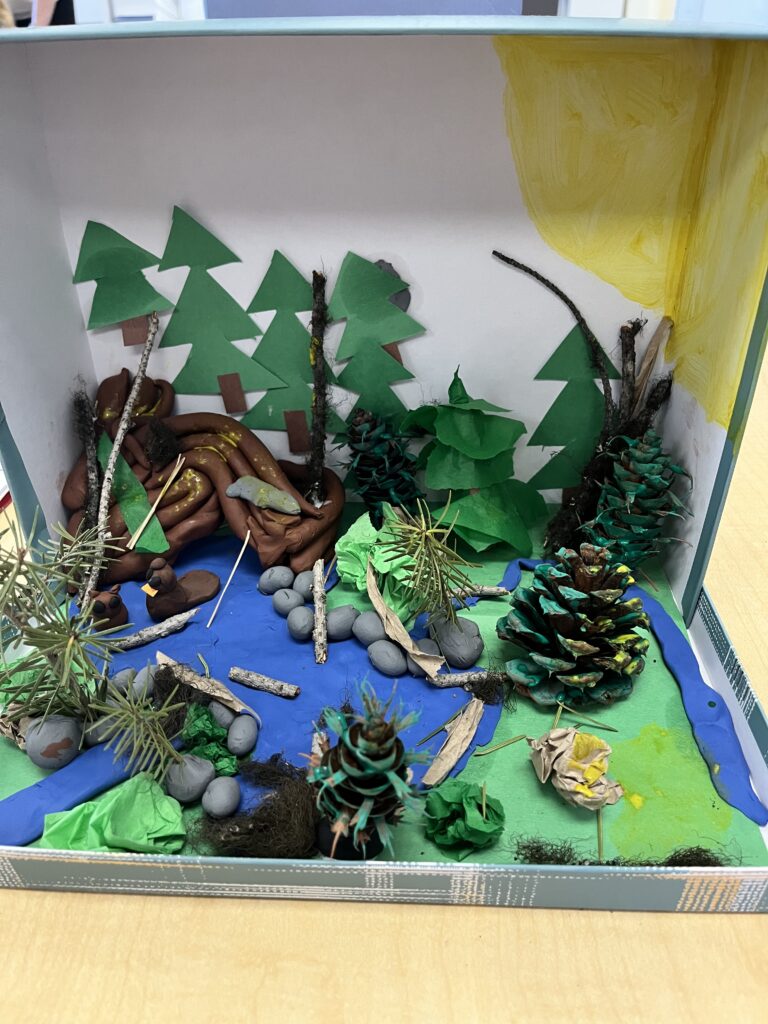
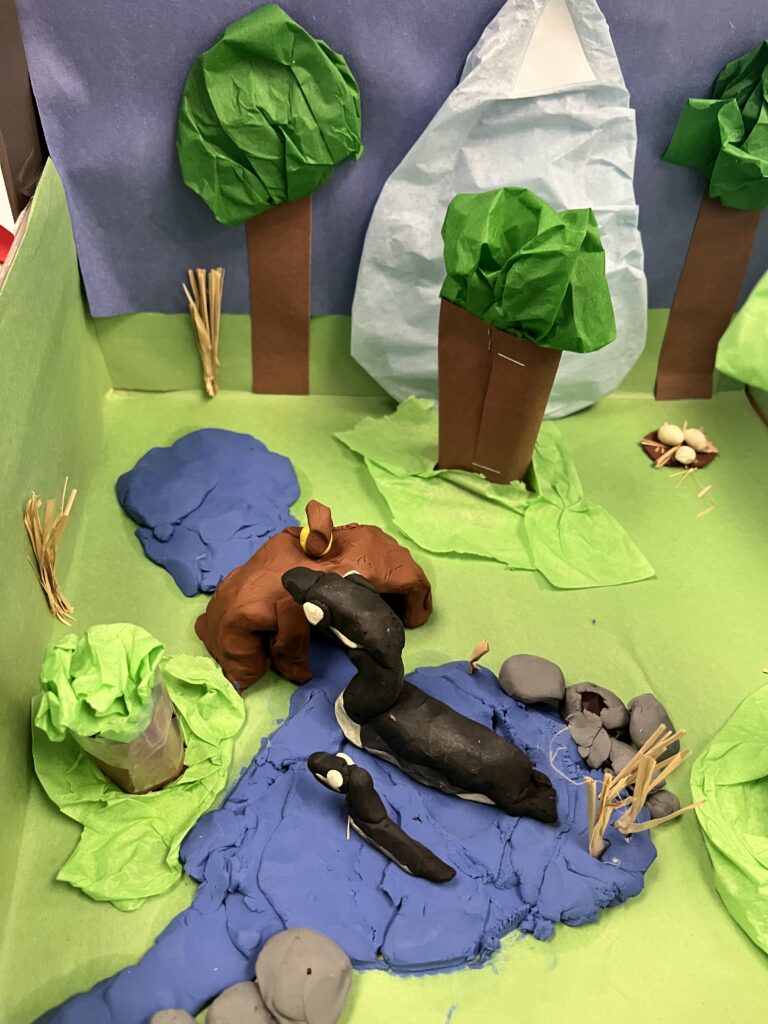
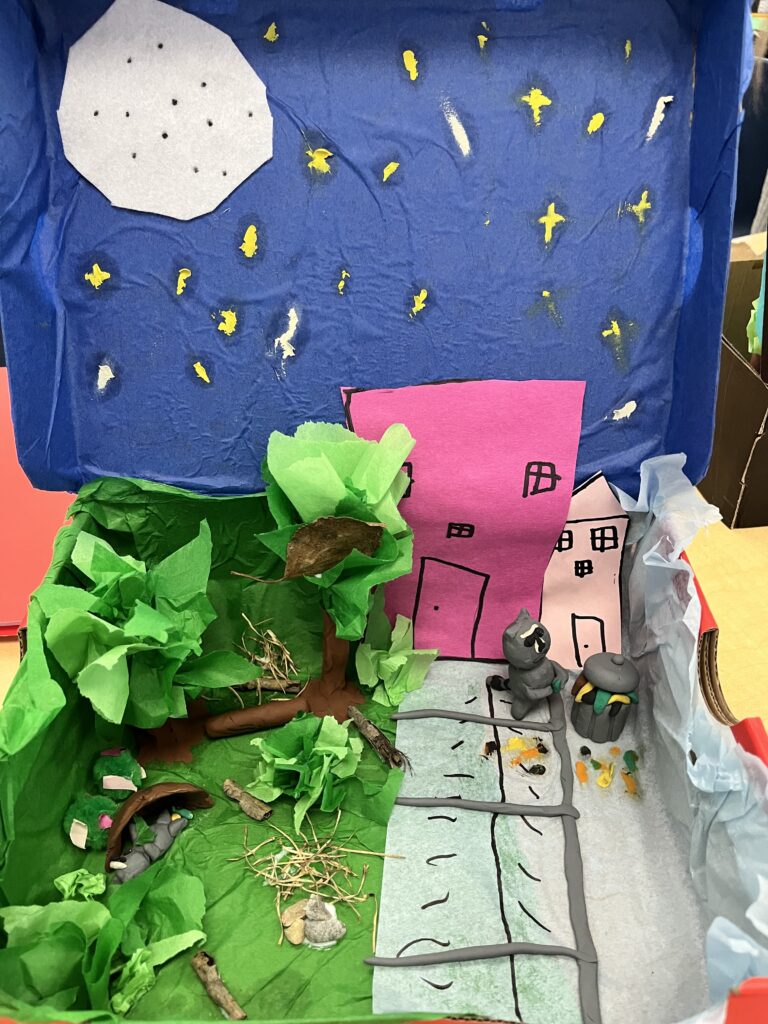
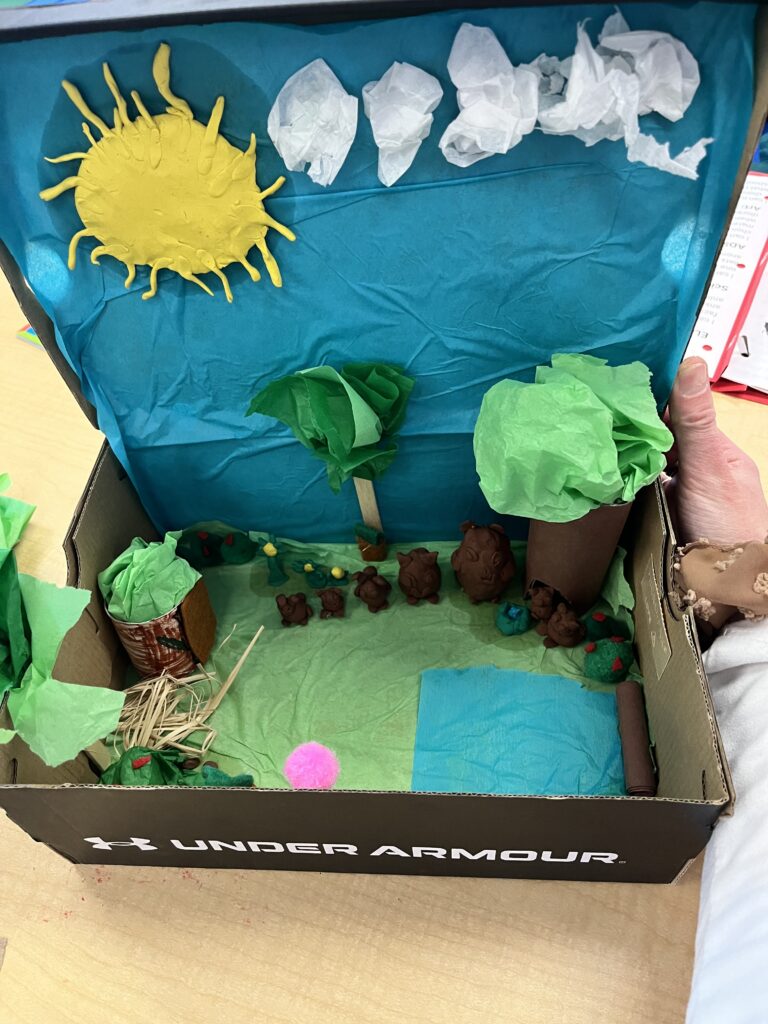
In a grade 2 science class we worked with students who had chosen a local animal. Our students were tasked with learning the animal name in Ktunaxa, creating a diorama of the animal’s habitat, and with completing a workbook including a self-assessment. This was a great way to do hands-on learning! My student chose the beaver and wanted to put the beaver lodge on the side of the diorama with no pond. We were able to talk through how the beavers would get into their homes if there was no door. We then looked back at the book to remind ourselves that the beavers needed to swim underwater to enter the lodge. You guessed it, we moved the lodge to sit on top of the pond instead. It was a great “aha” moment for my student, and for me.
I still wonder how to create these meaningful learning opportunities for my students while covering all of the required content. Inquiry based projects can take up a lot of time. I wonder if there is still a place for conventional worksheets or if it is better to create an environment where students to make a few lasting connections rather than learning all of the content items?
Phenomena have been observed for thousands of years. Many different cultures have told stories and legends about what has caused what they observed. These stories and legends have often included a god as the “cause” in the cause and effect relationship.
But what does this have to do with teaching? What does this have to do with how I as a Westerner interact with the local Ktunaxa people?
For me the profound, “aha” moment came for me when Phil talked about how we as a society are smarter than those who came before us. Not necessarily more intelligent, but smarter because we are standing on the shoulders of those who came before us. Settlers who came before us did not understand the immense importance of listening to the Ktunaxa people about caring for the land. Therefore when I think about a scientific understanding I am drawn back to thinking about what the Original People have to say.
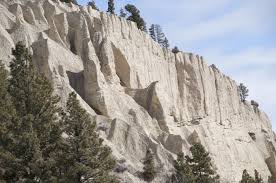
As a result, I can not discount the legends because they are not scientific. I see it as a different way of understanding. There is a scientific, Western understanding, that is valid and is useful in describing the physical reason for various phenomena. However, there is an equally valid spiritual, non-material, understanding as well. I often think that our Western understanding is hyper focused on the material world, and we lose sight of the beauty of the spiritual world. When I think about the Ktunaxa Creation story I am able to understand how important different understandings are because of the important relationships people have with the land when there is more than material at stake. The spiritual connection to landmarks like the hoodoos make taking care of the area an integral part of a person; however, if the connection is merely physical the connection is far easier to break.
An example of an activity I can use in my class to encourage thinking about various phenomena is described below:
The only addition I would like to make would be to consider non-material explanations as well. This could be a wonderful way to tie in English Language Arts. Perhaps the students are asked to write a legend about what has caused this to occur. Allowing space for alternative, non-Western, explanation honours different ways of understanding.
See (observe)
Think (interpret)
Wonder (hypothesis)
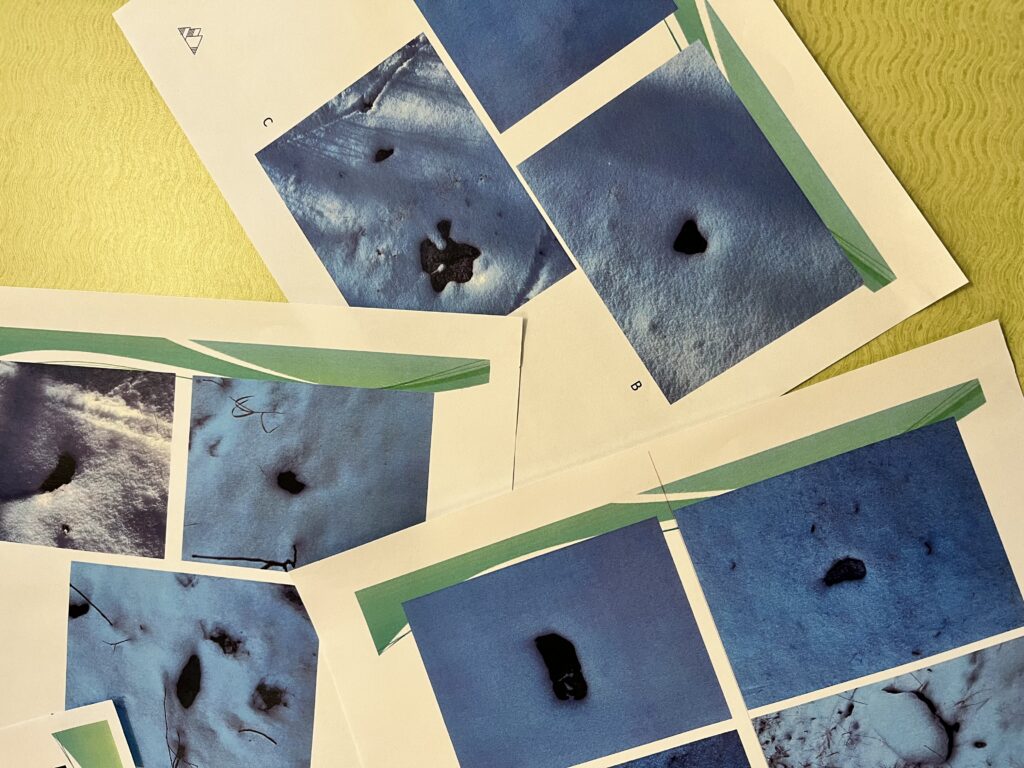
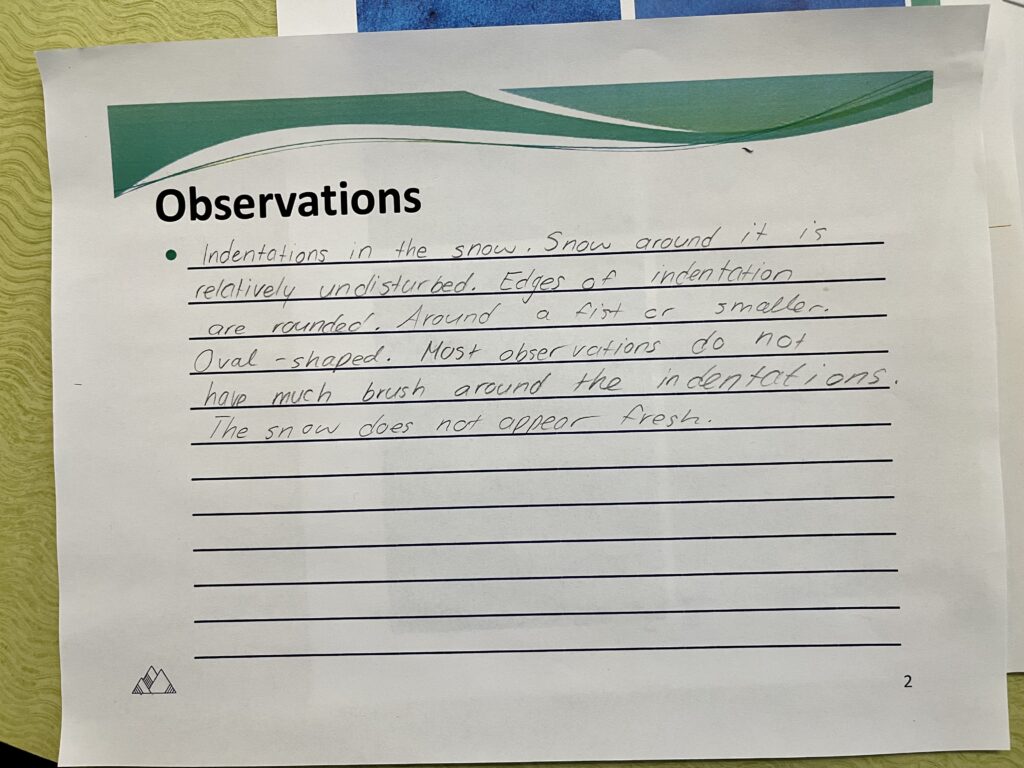
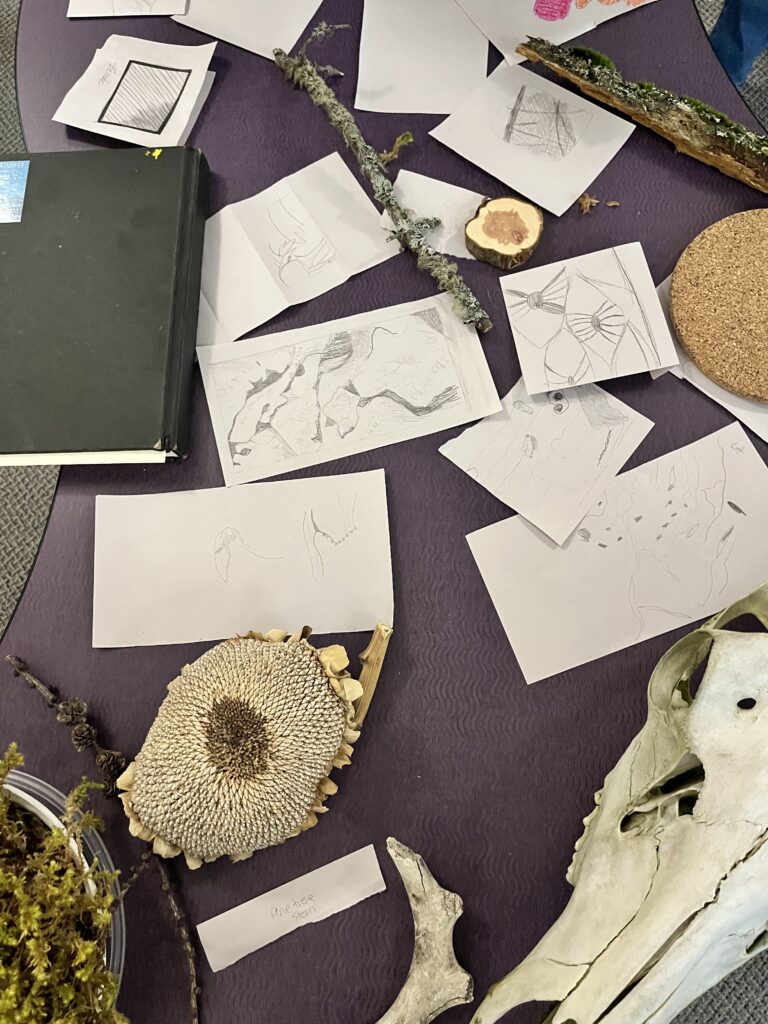
First observe a phenomenon. In our example we looked at pictures of rocks in snow. In this first step we were to record only what we saw and not make any conclusions at this point.
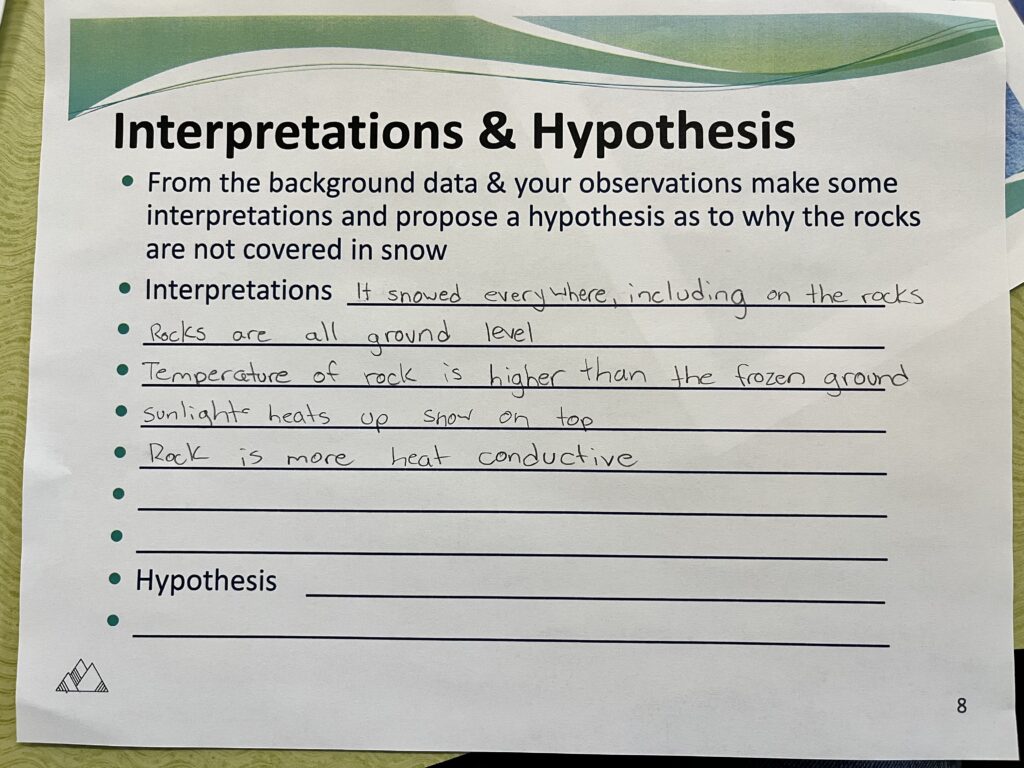
Next, we were to start interpreting our observations and putting the “puzzle” together.
Finally, in the hypothesis stage we were to suggest a reason for why this event was happening. This is the stage where an inquiry project with the phrase, “your ideas are really thought provoking, we are going to do some research to find out what is happening.”
I don’t think that I am alone in feeling like environmentalism has felt so daunting and hopeless that it is hard to know where to begin. I care so deeply about Creation, yet feel so powerless to contribute anything truly meaningful. I make my efforts: planting a garden, composting, and conserving water; but what does that even matter when the big polluters of the world pour toxins into the atmosphere? I’m just one person. How much of a difference can I really make? And how much mental energy can I afford in feeling guilty when there is a beautiful life to get on with?
I think I have fallen prey to ecophobia. I’ve been scared to the point of disassociation. I have consciously or subconsciously distanced myself from thinking about the state of the Planet and what the future holds. While I do think there is some wisdom in not becoming worried about things beyond your control, I also think there is some apathy that sets in.
Moving beyond echophobia, for me, requires us to step back and fall in love with the living world. Instead of becoming hostile towards it we simply need to spend time being in it.
In an educational setting this means taking our students outside. Planning activities that inspire empathy. For example, I loved the group that made bird wings for each child. They spent time being in the woods like birds: making nests and painting their wings to look like the birds they saw. This activity sparked the children’s natural curiosity to find out more about the birds: what did they eat, what did they need to survive, and how can I help? This activity is good for the primary years.
Other age appropriate activities for the intermediate years could be making maps of the local area around each child’s home, school, and community. Additionally, fort building outside in nature is very beneficial to connecting to the land at this age. Or perhaps exploring a creek to study the water cycle: “Wet sneakers and muddy clothes are prerequisites for understanding the water cycle” (Beyond Ecophobia, David Sobel, 1993).
Once children reach adolescence, around age 12-15, they are ready to start thinking beyond their own small world and expand their love of nature and the Earth. This is the stage where social action becomes appropriate.
Introducing environmentalism at age appropriate stages, and not all at once is important to stave off the feeling of despair that causes us to distance ourselves from the source of that worry. Let us move slowly and with love and patience to inspire our students and ourselves toward more.
Asters and Goldenrods. Purple and gold. These colours are pleasing to us for a very good reason. These colours complement each other. As Robin Wall Kimmerer notices, in Braiding Sweetgrass: Indigenous Knowledge, Scientific Wisdom, and the Teaching of Plants, these flowers do not need to be pleasing to humans for survival. So why do they bother, scientifically speaking? It just so happens, Kimmerer explains, that what is beautiful to us two legged creatures, is also pleasing to the winged pollinators.
This got me to thinking that just because I cannot explain something scientifically, whether that is because I lack the knowledge or because it has not been discovered yet, does not mean that the thing in question is to be discounted. For me this is profound as a teacher. While I want to teach my students the information that is in the Curriculum, I also want them to understand that the Western perspective is lacking. There is profound beauty in other ways of understanding.
In our science demonstrations I noticed just how beautiful food colouring is in cold water. A spreading orb of colour suspended in liquid, spreading as if in slow motion. There is of course a scientific explanation for this. However, that explanation does not discount the moment of peace and joy I felt at seeing that. I did not feel those things because I understood the molecules were moving slowly and were therefore not spreading the colour around as quickly as the hot water in the neighbouring container. No. It was a simple moment of observed beauty. If I can teach that to my students, that everything is connected, science-art-regulation-math-love-the whole world, then I will be a part of something truly beautiful.
Some tools I picked up that I do not want to forget are:
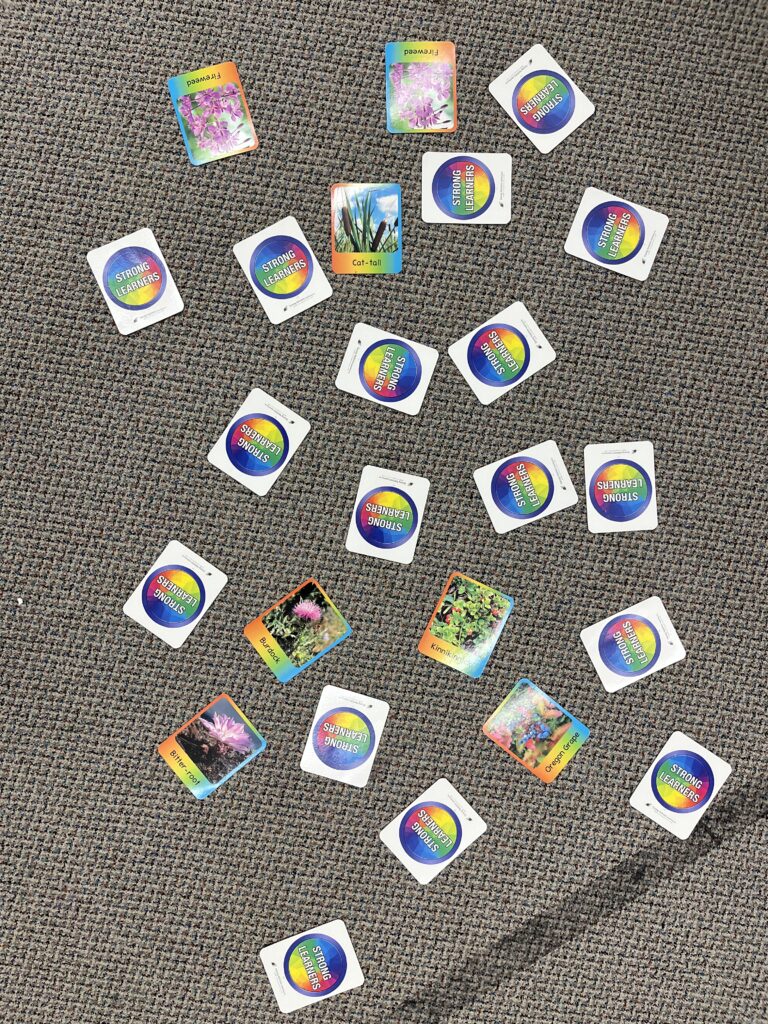
Using this matching game to learn local plants paired with the First Voices app to learn the names in Ktunaxa. In order to make the game go faster, leave the cards face up so kids can find a match easier.
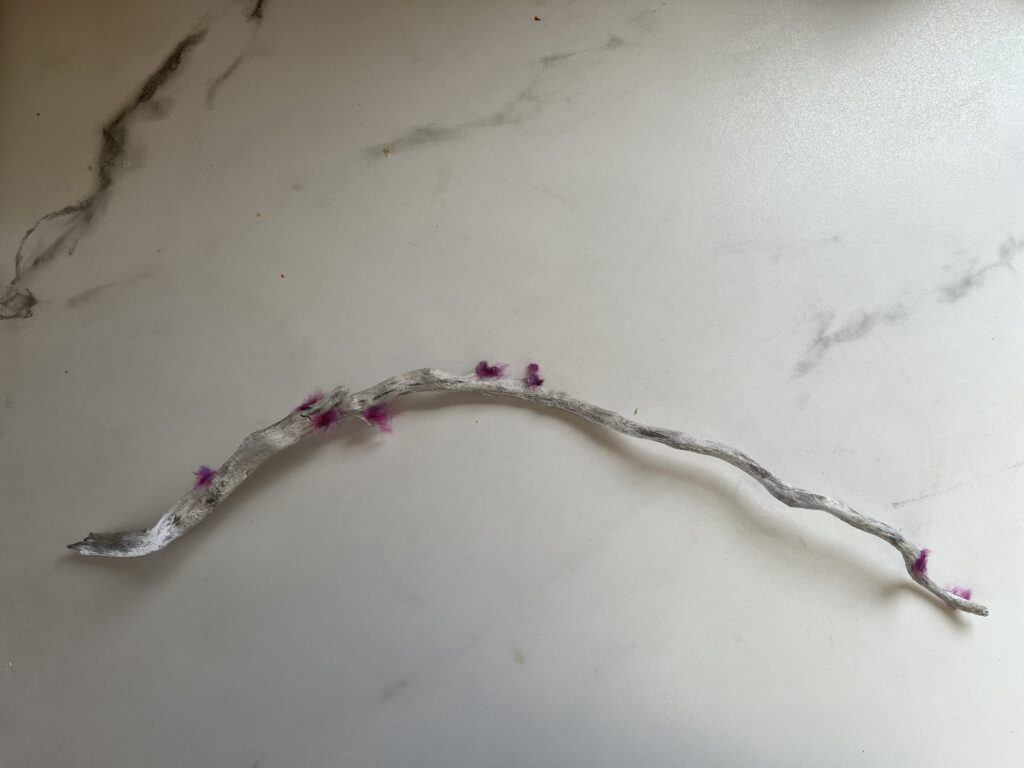
Also a great cross-curricular activity is to collect sticks and have the students make up a new plant. Have them write the name, how they found it, and what it is used for.
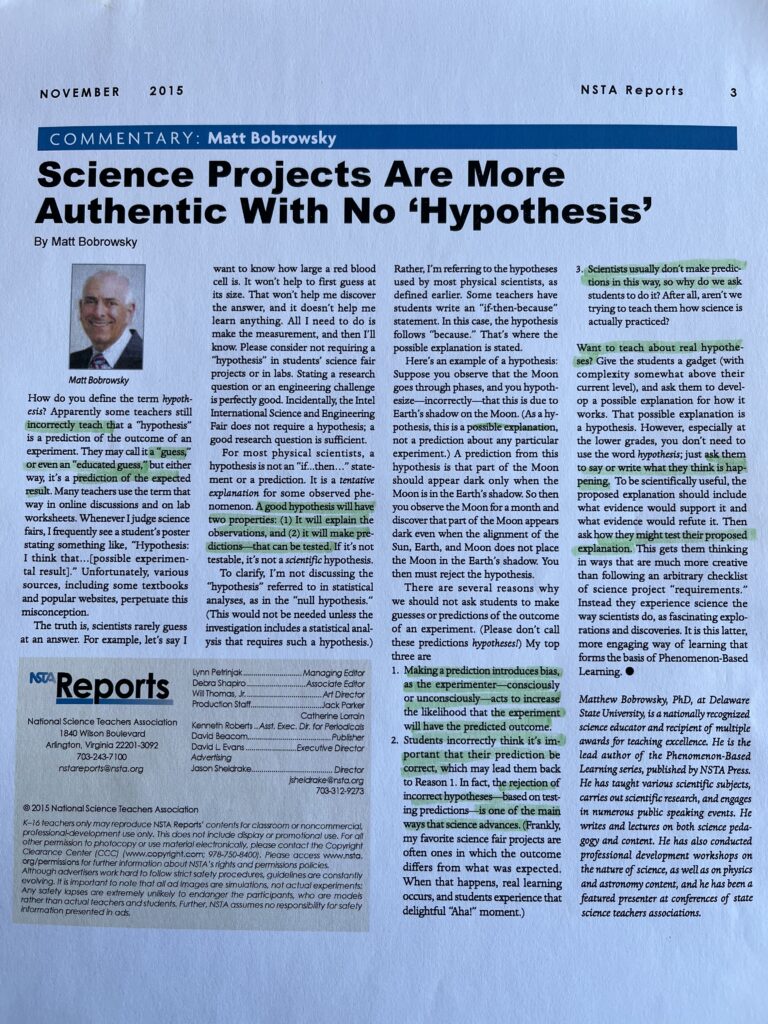
I grew up in a time, and I think many of us have, when we got ready for our school science fair every year. We would each come up with an hypothesis. We would employ the scientific method, create our tri-fold poster, and present. Job well done. But what about if we challenged the traditional science fair hypothesis tradition, and embraced instead what Matt Bobrowsky argues, that “science projects are more authentic with no ‘hypothesis’” (Bobrowsky, 2015)? I wonder how I can foster a love of learning and questioning without buying in to the old traditional ways of “doing the science fair”?
One way is to use the POE method: Predict, Observe, Explain. In this method students do not skew their results to fit what their hypothesis is, and engage in real learning to explain what they observe. This becomes a celebration of learning instead of a box to tick.
I wonder if this kind engagement will really prepare our students for the future and inspire new discovery.
I wonder how I might adapt the POE method for the early years and the intermediate-to-middle school years.
Coming from a liberal arts background the phrase “scientific observation” was slightly intimidating. However, when I began to understand that scientific observation can take the form of a sweet child wandering around her yard looking for evidence of fairies I was heartened.
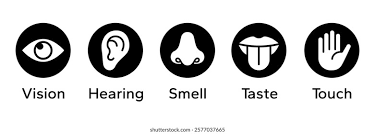
As an elementary teacher I can create activities that encourage my students to use all of their senses (maybe minus taste) to observe the world around them.
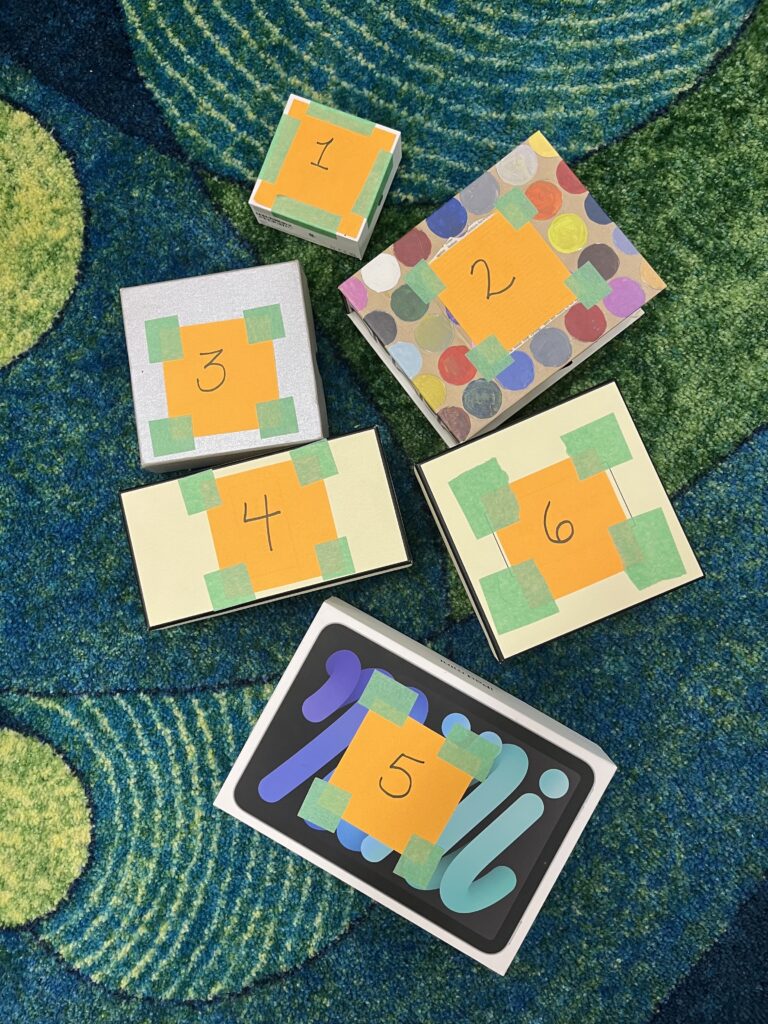
Here is an activity I learned in my Science Curriculum class that illustrates this exactly. To play, the teacher divides the class into 6 groups. Each group has a recording sheet and a numbered box. The group members use their senses to observe and predict what is inside the box. After each group has had each box the teacher reveals what is inside each box. This is a great game to play with all ages as I fully enjoyed it as an adult.
I still wonder how I can encourage curiosity and wonder, use Indigenous ways of approaching nature, and teach all that I need to teach in the Science Curriculum. Sometimes I feel like I am ill equipped. I imagine this is why we lean on one another as teachers, using ideas like those above, and become friendly thieves and generous givers.