Slow is faster than stuck. -Tom Frose

Author: lpasivirta (Page 1 of 2)

Story Vines

You’ve probably heard the old saying: we don’t truly understand something until we try to teach it to someone else. Speaking from experience this is absolutely true.Ā  According to Robin Bright, author of Sometimes Reading is Hard, one way to build our students’ reading and oral fluency is to create a story vine (2021, pp.91-93).Ā 

What is a ‘Story Vine’?

What is a story vine you ask? Well, let me tell you!

Bright explains that Story Vines “are based on an old African tradition of storytelling and can be used to develop language and support reading and writing across the curriculum” (Bright, 2021, p. 91).

Robin Bright cites Marlene McKay who argues that Story Vines are a great tool for developing a student’s “reading skills while collaborating and contributing to meaningful classroom talk” (Bright, 2021, p. 91).

Below is a page from McKay’s book, Story Vines and Readers Theatre: Getting Started (2008, p.37).

The Process

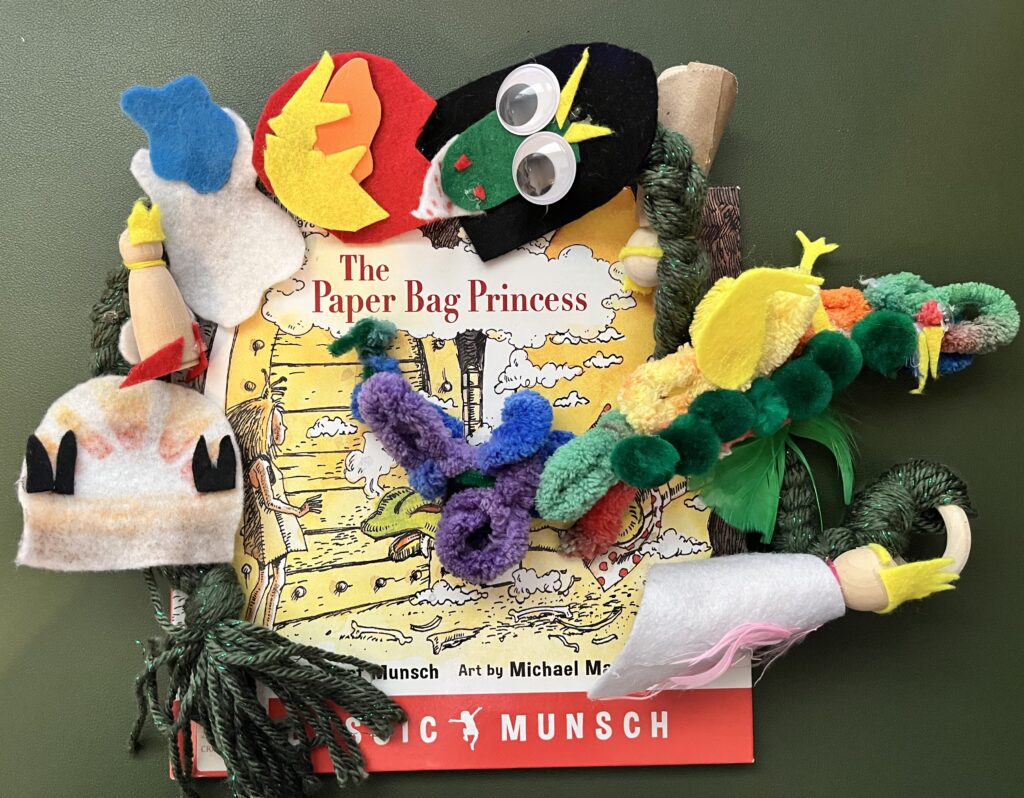
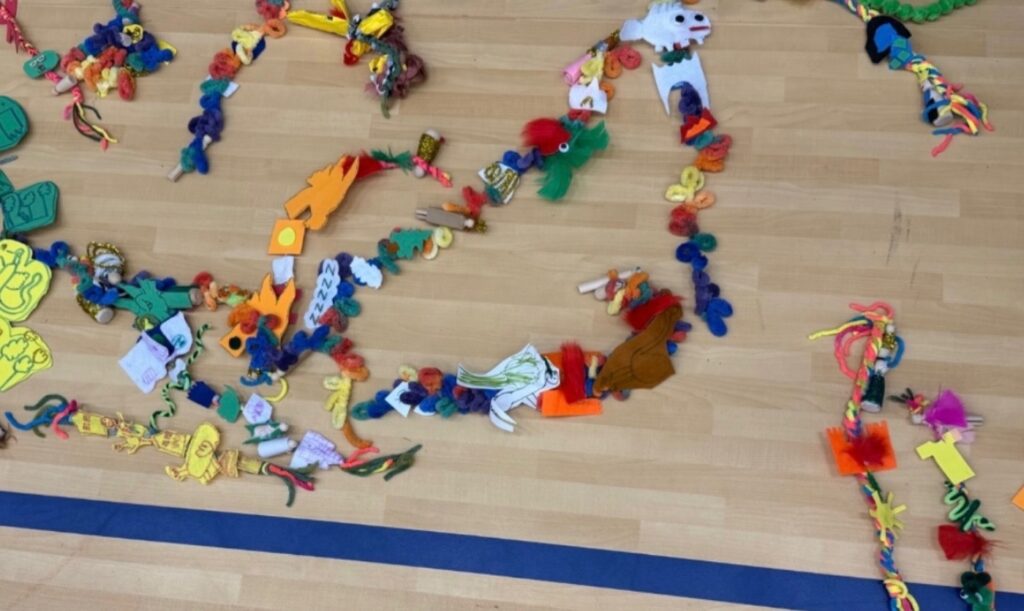
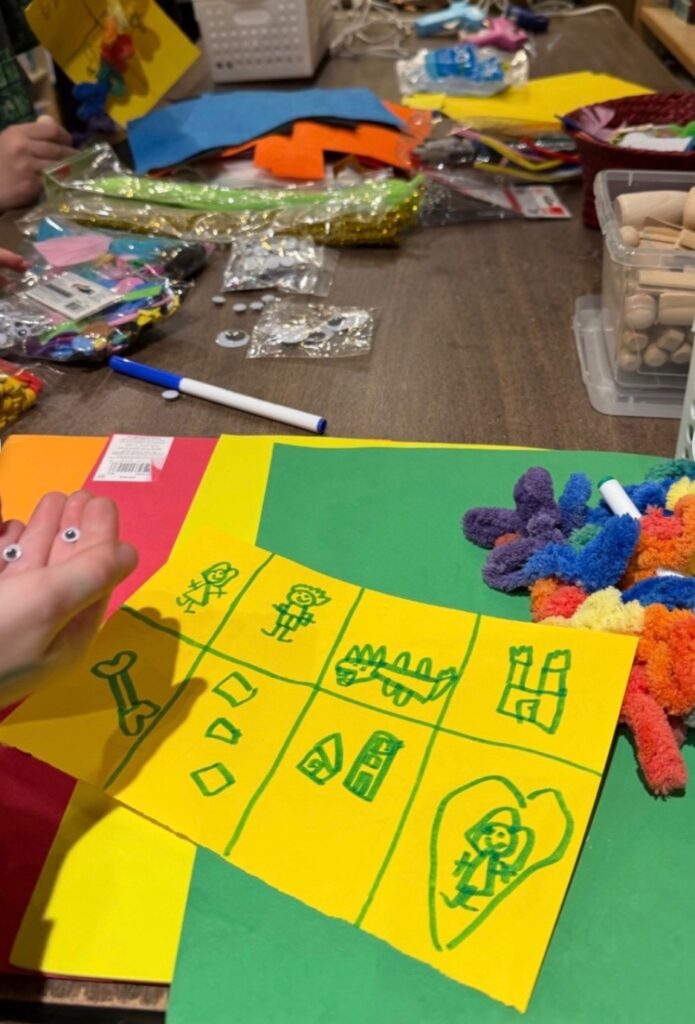
When our teacher education class made Story Vines with a grade 2/3 class this is what we did…

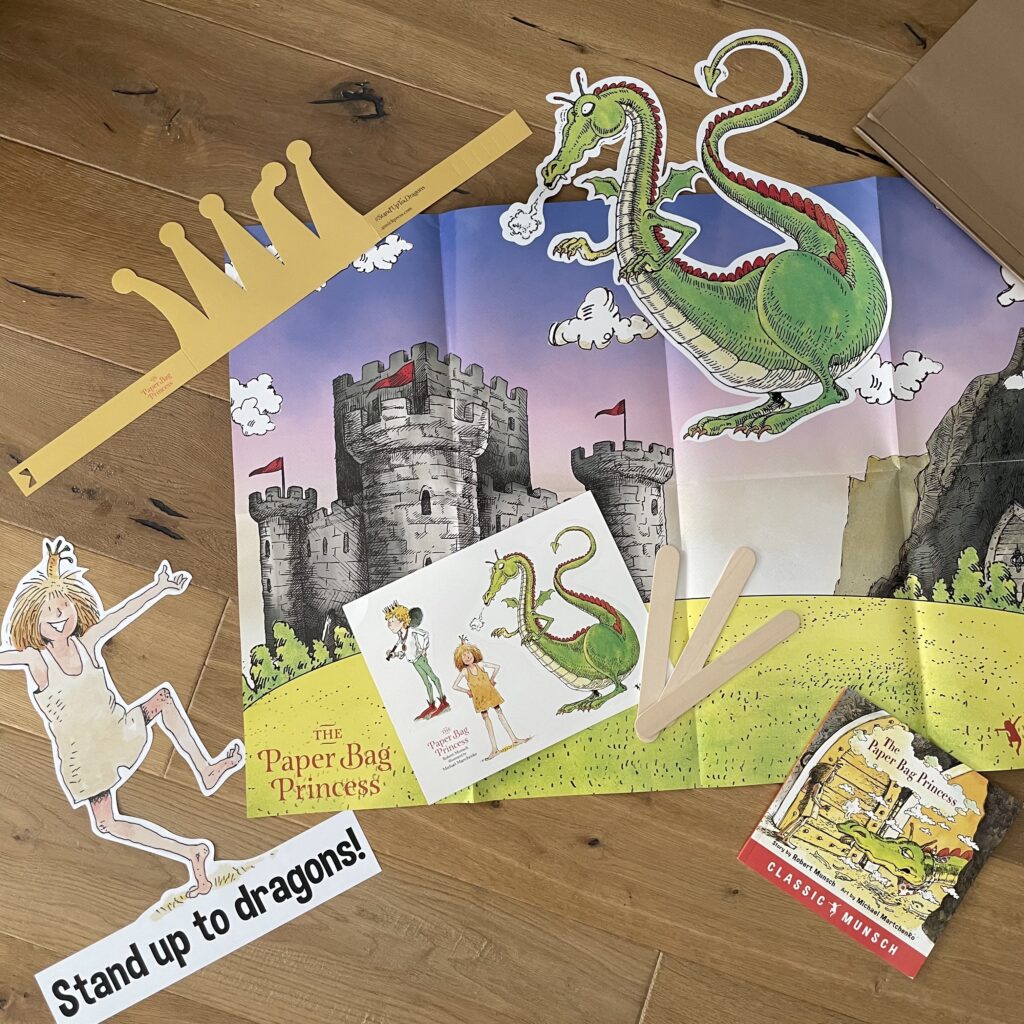
First, choose a book. For this activity we chose The Paper Bag Princess by Robert Munsch.Ā 

Second, using yarn, rope, or sturdy string you make a braid that is about arms length (pro tip, the yarn pieces should be from the floor to the person’s outstretched arm). Then gather craft supplies to create the elements of the story vine.Ā 

Third, instruct your students to listen to the story and pick important events that they will use to retell the story to someone else. Our grade 2/3 students used their vines to tell the story to kindergarteners. 

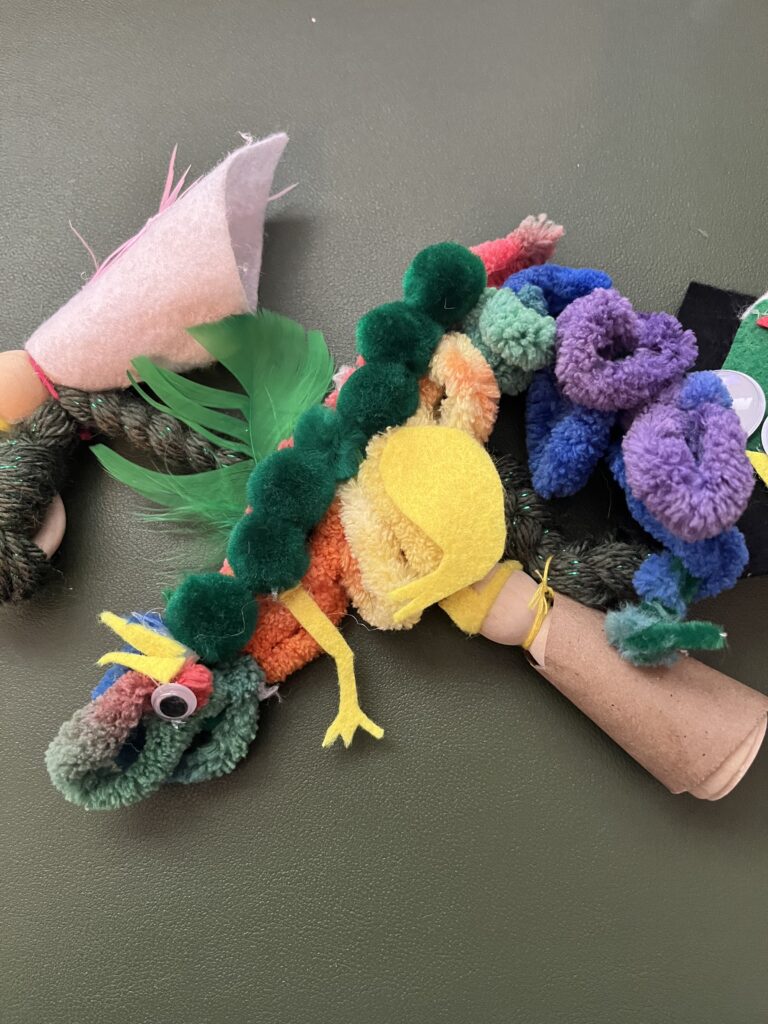
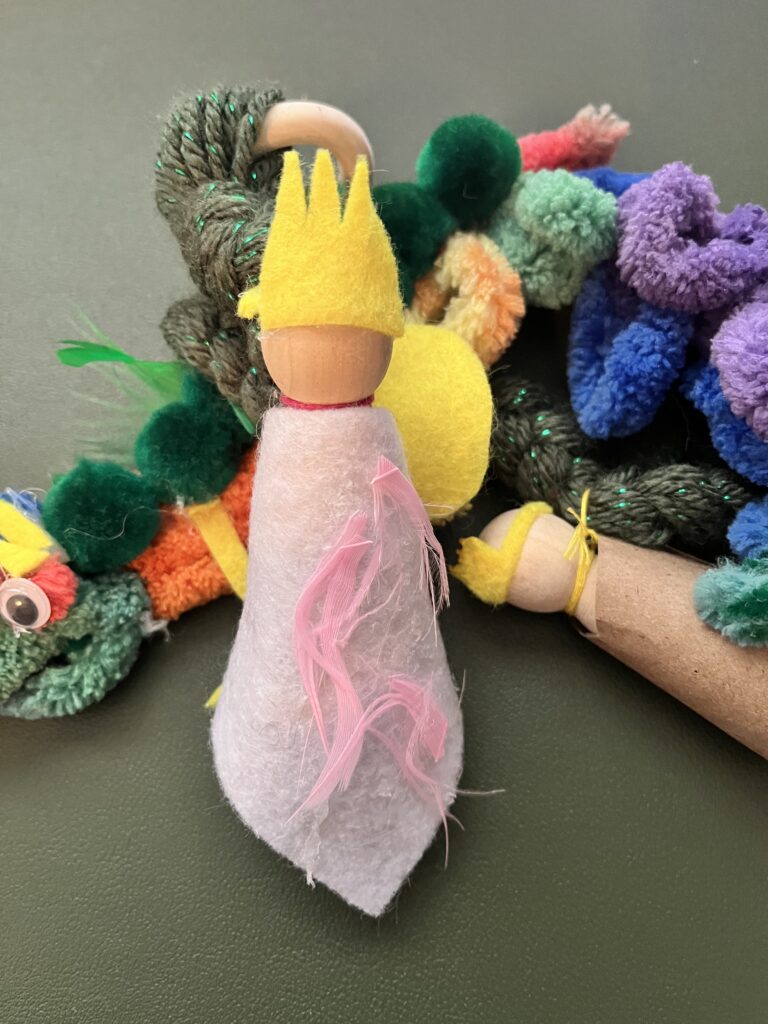
Fourth, students should create the ā€œcharactersā€ or ā€œpicturesā€ that will go onto their vines.

Fifth, put it all together and share with a classmate. 

Reflection on the Experience
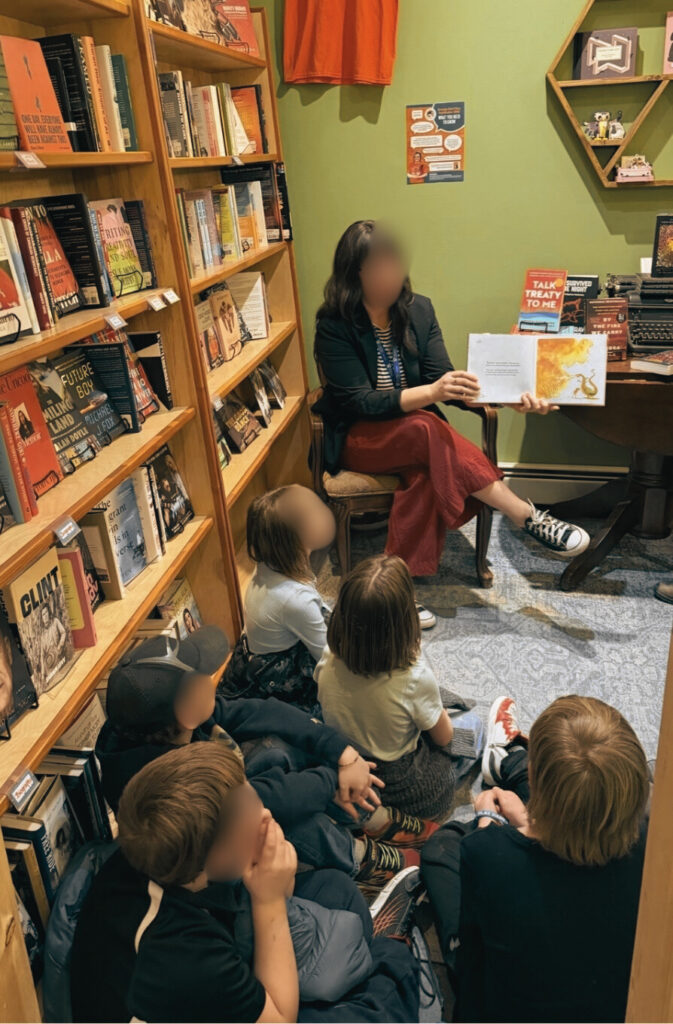
Our students were really engaged with this activity. While some were not really into The Paper Bag Princess, and chose to highlight Prince Ronald’s role in the story more so than Princess Elizabeth, I did hear them ask to do another Vine that was about a preferred book. Allowing students a choice in books is a great way to help them connect with the process. 

Considering my own reading journey, I think I would have really benefited from this kind of activity as it challenges the creator to think about the key moments in a story to be able to retell it. 
Screenshot

What is really wonderful about this activity is that you can adapt it for nearly all ages and subject areas. As McKay shows in her book, you can use this in a variety of situations with all ages. I love the idea of using this for social studies to create timelines. What about giving it as an option for a cheat sheet for a science test? There are so many different learning styles, and this would be a great way for a student to solidify their learning. This, in combination with a conversation, could be a great summative assessment for many different students.Ā 

Screenshot

BC Curriculum Connection

First Peoples Principle of Learning: Learning is embedded in memory, history, and story. The students get to participate in the power of oral story telling, while deepening their ability to listen for important details when hearing a story. 

All from the grade 4 English Language Arts BC Curriculum:

Curricular Connections:

Big Ideas: Language and text can be a source of creativity and joy. 

Curricular Competencies:
Comprehend and Connect:  Use a variety of comprehension strategies before, during, and after reading, listening, or viewing to deepen understanding of text
Create and Communicate:  Use oral storytelling processes

Content:
Strategies and Processes: reading strategies, oral language strategies, writing processes
Language features, structures, and conventions: features of oral language

References

Bright, R. M. (2021). Sometimes reading is hard: Using decoding, vocabulary, and comprehension strategies to inspire fluent, passionate lifelong readers. Hawker Brownlow Education, 91-93.

Curriculum. (n.d.-a). https://curriculum.gov.bc.ca/

FNESC (n.d.). First peoples principles of learning. First Nations Education Steering Committee. https://www.fnesc.ca/first-peoples-principles-of-learning/

McKay, M. (2008). Story vines and readers theatre: Getting started. Portage & Main Press, 37.
Building a Diverse Classroom LibraryĀ 

When curating a classroom library ensure that BIPOC books fully develop the character and ensure the protagonist is not objectified or used to teach a moral lesson (Harde, 2016). 

Indigenous Books

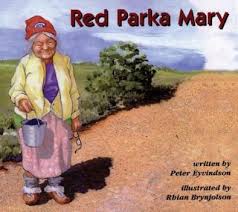
Harde quotes Clare Bradford who states ā€œsettler-society texts,ā€ or books written by non-indigenous writers, can be used when authors, like Peter Eyvindson, create books wherein ā€œIndigenous children can find themselves and their community depicted in positive and human ways in a variety of settings, urban, rural, and reserveā€ (Harde, 2016, p. 5).  Eyvindson’s books are: Red Parka Mary, Jen and the Great One, Kookum’s Red Shoes, and Kyle’s Bath.

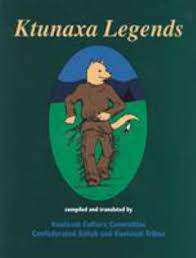
Harde talks a lot about using literature that is grounded in Oral Storytelling. Ktunaxa Legends comes to mind. Using a local resource like this will be a part of my diverse classroom. 

Some other books I would like to include in my classroom library are: 

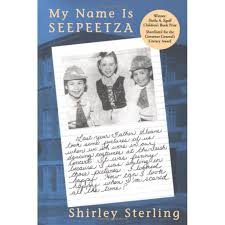
My Name is Seepetza by Shirley Sterling. This novel is about a 6 year old girl going to residential school. 

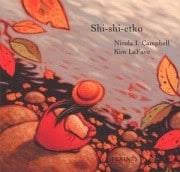
Shi-Shi-etko by Nicola I. Campbell. This story book is about a young girl and her family preparing for her to leave home for residential school.

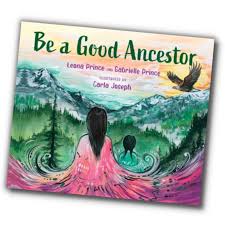
Be a Good Ancestor by Leona Prince and Gabrielle Prince. This picture book encourages the reader to consider how they are connected to the world around them. 

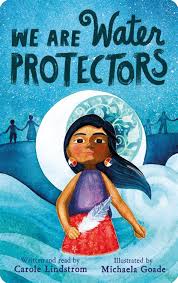
Water Protectors by Carole Lindstrom. This picture book encourages readers to protect the water as it is the source of life. 

BIPOC Books

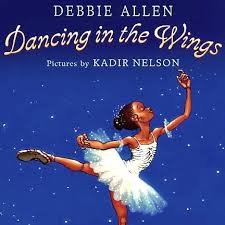
Dancing in the Wings by Debbie Allen. This picture book is about Sassy, a ballerina with big feet. Sassy is embarrassed by her feet, but in the end those feet allow her to do great things. 

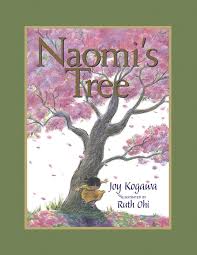
Naomi’s Tree by Joy Kogawa. This picture book is about Naomi, the heroine from Naomi’s Road and Obasan. This is an age appropriate introduction to Japanese Internment. 

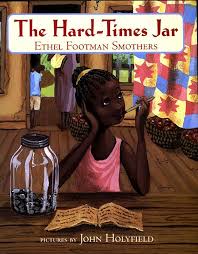
The Hard-Times Jar by Ethel Footman Smothers. This picture book is about distinguishing between want and need and a young girl’s love of reading and writing. 

Inclusive Books

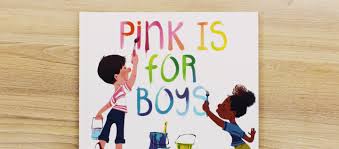
Pink is for Boys by Robb Pearlman. This picture book is about celebrating everyone and rethinking stereotypes. 

Read Aloud to All Ages

According to Molly Ness, author of Read Alouds for all Learners, students of all ages love to be read to. These books could either stand on their own as a novel study in the case of My Name is Seepetza, or as an anchor book for a larger unit.

BC Curriculum Connections

Using diverse books meets the BC Curricular Competency: recognize the validity of First Peoples oral tradition for a range of purposes (comprehend and connect-grade 7), recognize the role of language in personal, social, and cultural identity (comprehend and connect-grade 4), and recognize the importance of story in personal, family, and community identity (comprehend and connect-kindergarten).

Ideas to Encourage a Diverse Classroom

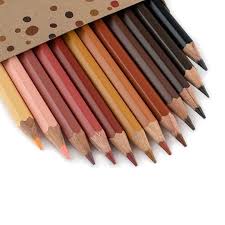
Other ways to increase diversity in my classroom will be to include a variety of options for skin colour. Growing up everyone was coloured peach or light pink. I think assumptions like this create a white-centric world view, and in small communities where there is not a lot of diversity it is even more important for teachers to provide opportunities for our students to broaden their thinking.

References

Harde, R. (2016). Putting first nations texts at the center. Bookbird: A Journal of International Children’s Literature, 54(1), 4–9. https://doi.org/10.1353/bkb.2016.0019 

Curriculum. (n.d.-a). https://curriculum.gov.bc.ca/

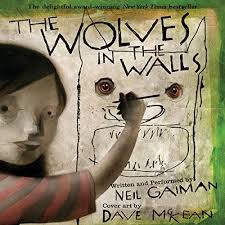
The Wolves in the Walls

by Neil Gaiman

Virtual Reality for Literacy

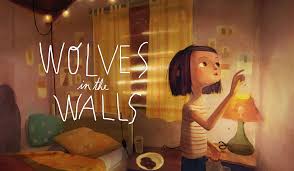
I embarked on my first experience with Virtual Reality (VR) this week! I had heard of it of course, but I had never used one before. Man was it ever a blast!! I am so glad I got to try it first before bringing it into a classroom setting. We started off in the local Design Lab. Many Teacher Candidates got to try out the app that we would be using with the students the following day. It was wonderful. I actually enjoyed the VR so much more than I thought I would. 

Read Aloud in Different Locations

The following day we all met and divided the jobs to be done with the students. First the students would all listen to the book read aloud. Another really cool thing we did was to split the long story up into 5 sections. Each section was read by a different person. The small groups of students cycled through each of the 5 sections, which were placed around the school. This kept the students engaged because they were never sitting for too long. I also really enjoyed reading the same section repeatedly because I got more into the voices and the characters each time I read it. The last group definitely got the best reading of them all. One thing I really noticed is that I read slower and took my time with each word to really get the most of it. 

English Language Arts: booklet work

Following the reading, the students could either work on a booklet that encouraged them to think about the story they had read, or have a chance to try out the story in the VR app. We did not have enough VR sets for each student so many had to wait for their turn.

BC Curriculum Connections

When considering the BC Curriculum and where an activity like this fits in I think immediately of English Language Arts (ELA). Of course. 

Grade 6:  ELA

Big Idea: Exploring and sharing multiple perspectives extends our thinking.

Curricular Competency: Recognize and appreciate the role of story, narrative, and oral tradition in expressing First Peoples perspectives, values, beliefs, and points of view. 

Content: Language features, structures, and conventions. 

First Peoples Principles of Learning: Learning is embedded in memory, history, and story. The students got to experience a story in a different way.

However, ELA is not the only application for a story like this. 

In grade 5 math you could use the VR to estimate the area and perimeter of different rooms in the house. Additionally you could establish a timeline of events that are happening throughout the story. 

In grade 5 science you could compare the muscular skeletal system of wolves to humans. There may even be some bones to bring into class of other animals found in this region. You could compare similarities and differences. 

There are so many applications for using VR in classrooms. For example, the following day the VR headsets were used in a grade 8 science class to teach cell theory and types of cells. There are so many great ideas! 

Movement Breaks for the WIN!

I had such a wonderful time reading a section of the book to all the groups of students as they moved through the different sections of the book and the school. I think this was a wonderful way to read the book as it built in movement breaks to an otherwise very long book. I also loved reading the same section over and over again because I got better at reading it. I’m sure there is an application there for doing Readers Theatre.

Here is another great idea I want to save for the future!

References

Curriculum. (n.d.-a). https://curriculum.gov.bc.ca/

First peoples principles of learning. First Nations Education Steering Committee FNESC. (n.d.-a). https://www.fnesc.ca/first-peoples-principles-of-learning/

Literacy Stations

Magic E Literacy Stations

The ā€œMagic eā€ or the ā€œBossy eā€ can be a struggle for many readers. I created a literacy station focusing on this topic. 

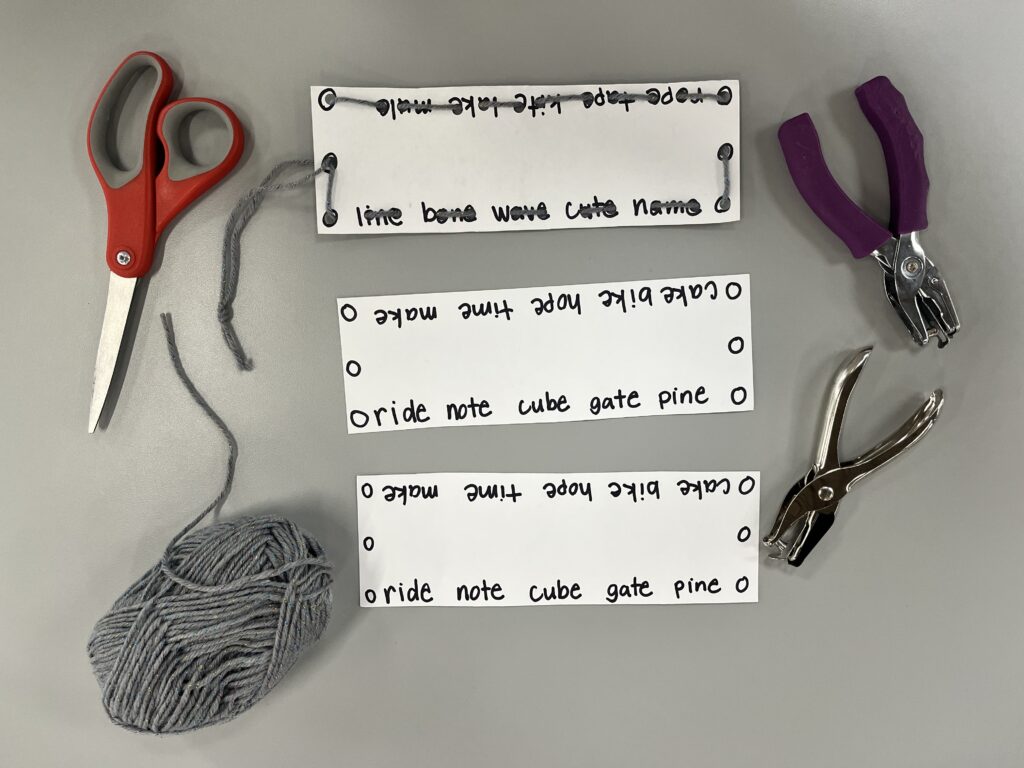
I cut cardstock into four sections. In each section I wrote ten ā€œmagic eā€ words to create a border. Each student had to use an individual hole-punch to punch out the ā€œmagic e.ā€ 

Together as a group we read each word first, punched the ā€œmagic e,ā€ then read the word that was left. Some words made sense like ā€œnoteā€ became ā€œnot,ā€ while others did not make sense like ā€œgateā€ turned into ā€œgat.ā€ In the future, I would choose words that all made different words when the “e” was taken off.

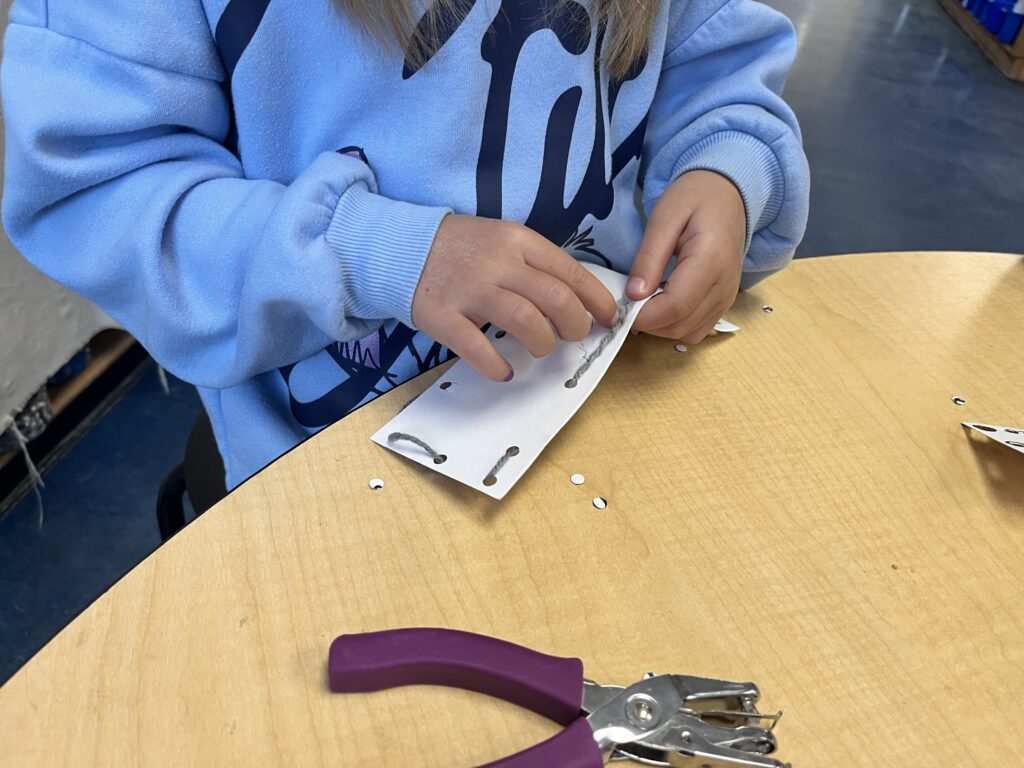
Many students found using the hole-punch hard at the beginning, but once they got the hang of it they really loved it. 

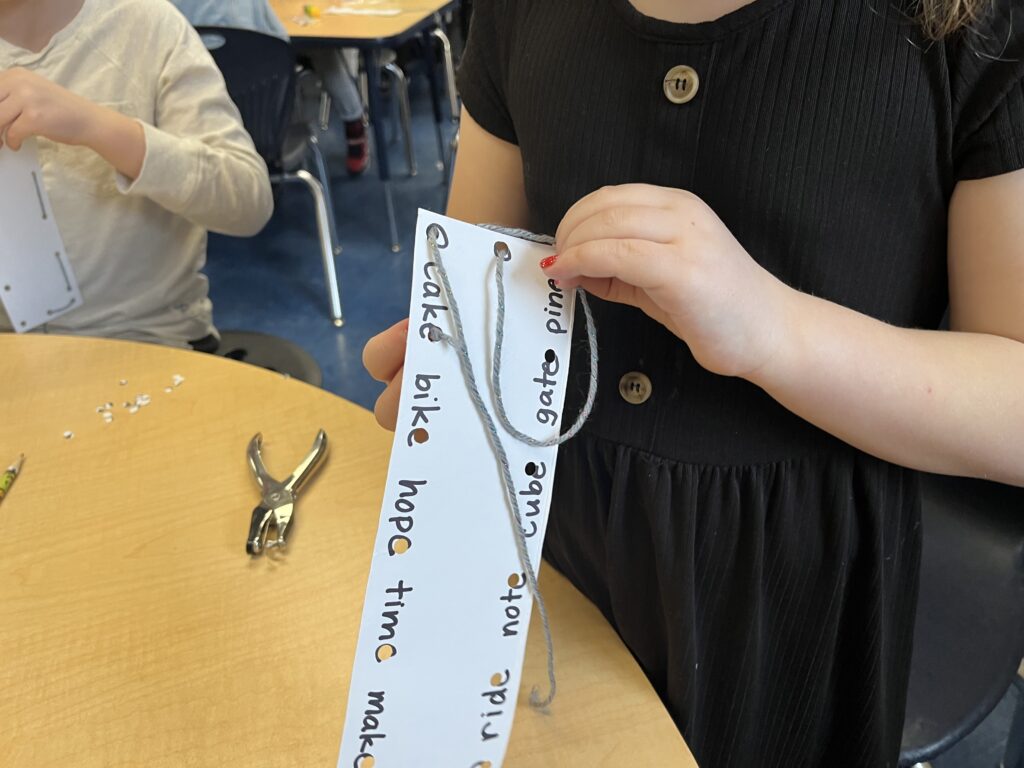
As a final piece the students thread a string of yarn through all of their punched holes to create a bookmark. Most students did not have time for the yarn part of the activity, but a few did. They took the yarn to finish at home. 

All in all I will use this centre again. I will need to pre-teach how to use the hole-punch. Specifically, where the paper goes, how to line the metal punch up with the spot you need to put a hole in, and how to use both hands. However, I think the skill of using a hole-punch, gaining hand strength, and working on fine motor skills by threading the yarn through the holes make this a worthwhile activity. Plus many students said it was FUN! Always a win!! 

Materials Needed:
Cardstock (1-2 quarters per student)
Individual hole-punch per student in the group
Yarn
Scissors
Sharpie

BC Curriculum Connections

Big Idea: Playing with language helps us discover how language works.

Curricular Competency: Use developmentally appropriate reading, listening, and viewing strategies to make meaning

Content: Strategies and processes: reading strategies 

Core Competency: Critical Thinking and Reflective Thinking

Profile 2: I can use evidence to make simple judgments.

Profile 4: I can gather and combine new evidence with what I already know to develop reasoned conclusions, judgments, or plans.

First Peoples Principles of Learning: Learning is holistic, reflexive, reflective, experiential, and relational (focused on connectedness, on reciprocal relationships, and a sense of place). This literacy station used experience and a tactile approach to learn this concept.

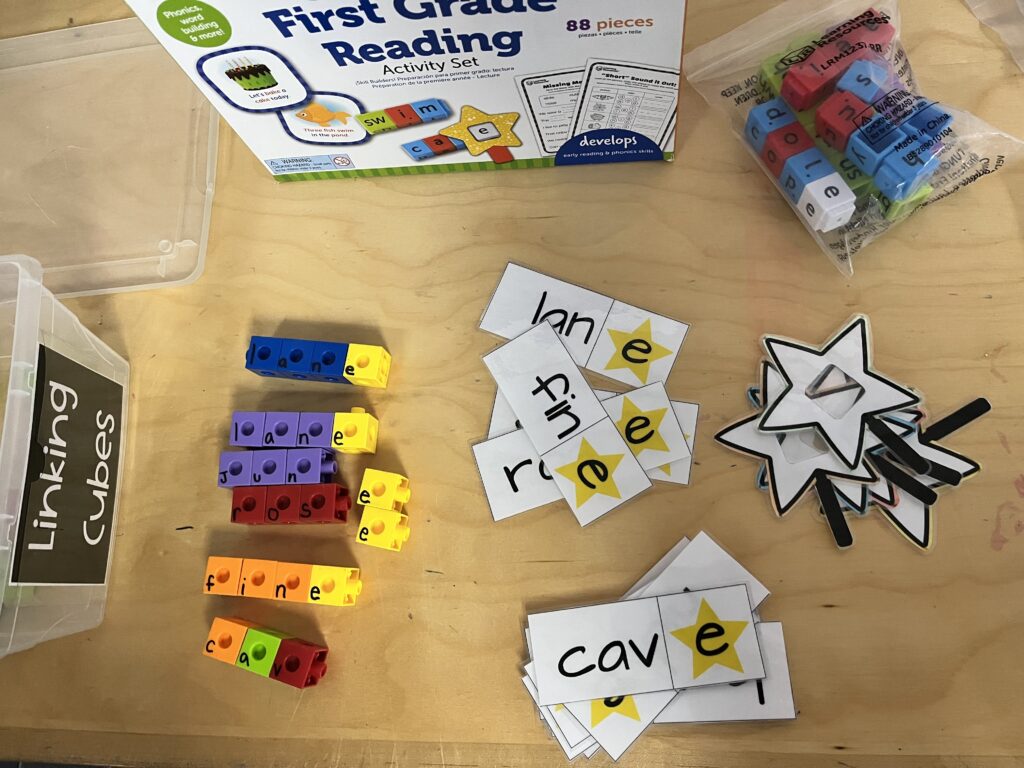
Another literacy station that was used in the class used linking cubes with the letters on each block. Students had to put the word together on the corresponding word.

Boosting Reading Comprehension

Other ways to boost reading comprehension beyond literacy stations are to teach the following:
1. “Engage students in self-aware, active reading
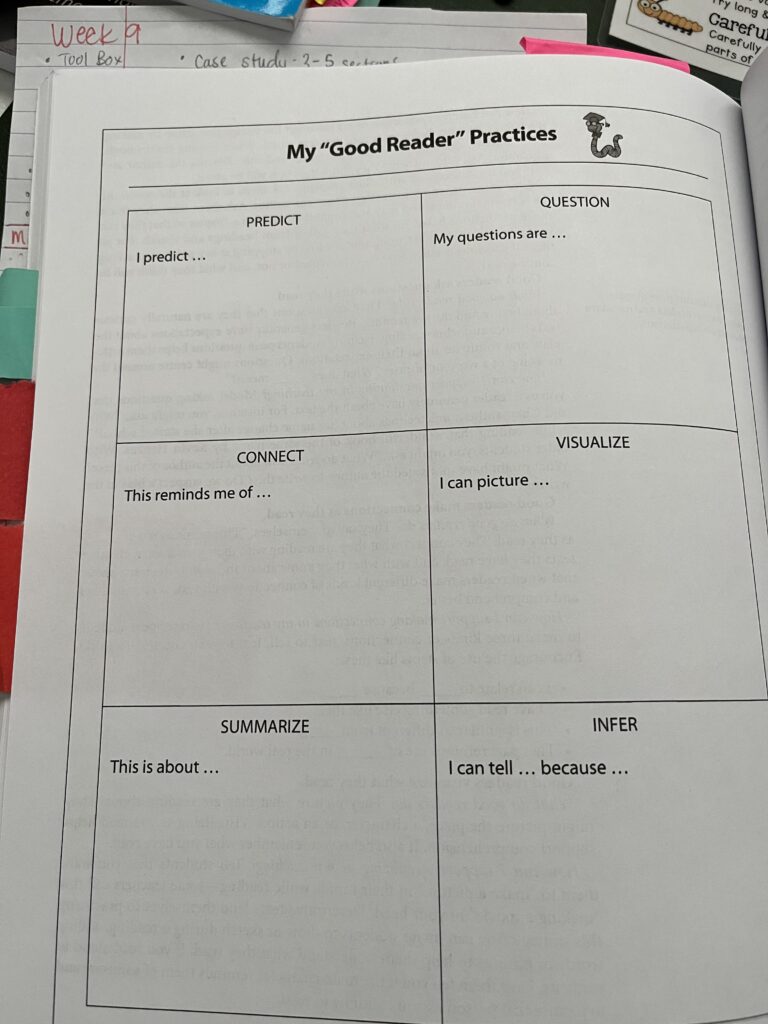
2. Teach the practices of good readers
3. Teach text structures
4. Seek out mentor texts
5. Organize book clubs” (Bright, 2021, p.34)

References

Bright, R. M. (2021). Sometimes reading is hard: Using decoding, vocabulary, and comprehension strategies to inspire fluent, passionate lifelong readers. Hawker Brownlow Education, 134-147.
Curriculum. (n.d.-a). https://curriculum.gov.bc.ca/
First peoples principles of learning. First Nations Education Steering Committee FNESC. (n.d.-a). https://www.fnesc.ca/first-peoples-principles-of-learning/

Phenomenon

Phenomena have been observed for thousands of years. Many different cultures have told stories and legends about what has caused what they observed. These stories and legends have often included a god as the ā€œcauseā€ in the cause and effect relationship.Ā 

But what does this have to do with teaching? What does this have to do with how I as a Westerner interact with the local Ktunaxa people? 

For me the profound, ā€œahaā€ moment came for me when Phil talked about how we as a society are smarter than those who came before us. Not necessarily more intelligent, but smarter because we are standing on the shoulders of those who came before us.Ā Settlers who came before us did not understand the immense importance of listening to the Ktunaxa people about caring for the land. Therefore when I think about a scientific understanding I am drawn back to thinking about what the Original People have to say.

As a result, I can not discount the legends because they are not scientific. I see it as a different way of understanding. There is a scientific, Western understanding, that is valid and is useful in describing the physical reason for various phenomena. However, there is an equally valid spiritual, non-material, understanding as well. I often think that our Western understanding is hyper focused on the material world, and we lose sight of the beauty of the spiritual world. When I think about the Ktunaxa Creation story I am able to understand how important different understandings are because of the important relationships people have with the land when there is more than material at stake. The spiritual connection to landmarks like the hoodoos make taking care of the area an integral part of a person; however, if the connection is merely physical the connection is far easier to break.

An example of an activity I can use in my class to encourage thinking about various phenomena is described below: 

The only addition I would like to make would be to consider non-material explanations as well. This could be a wonderful way to tie in English Language Arts. Perhaps the students are asked to write a legend about what has caused this to occur. Allowing space for alternative, non-Western, explanation honours different ways of understanding.

See (observe)

Think (interpret)

Wonder (hypothesis)

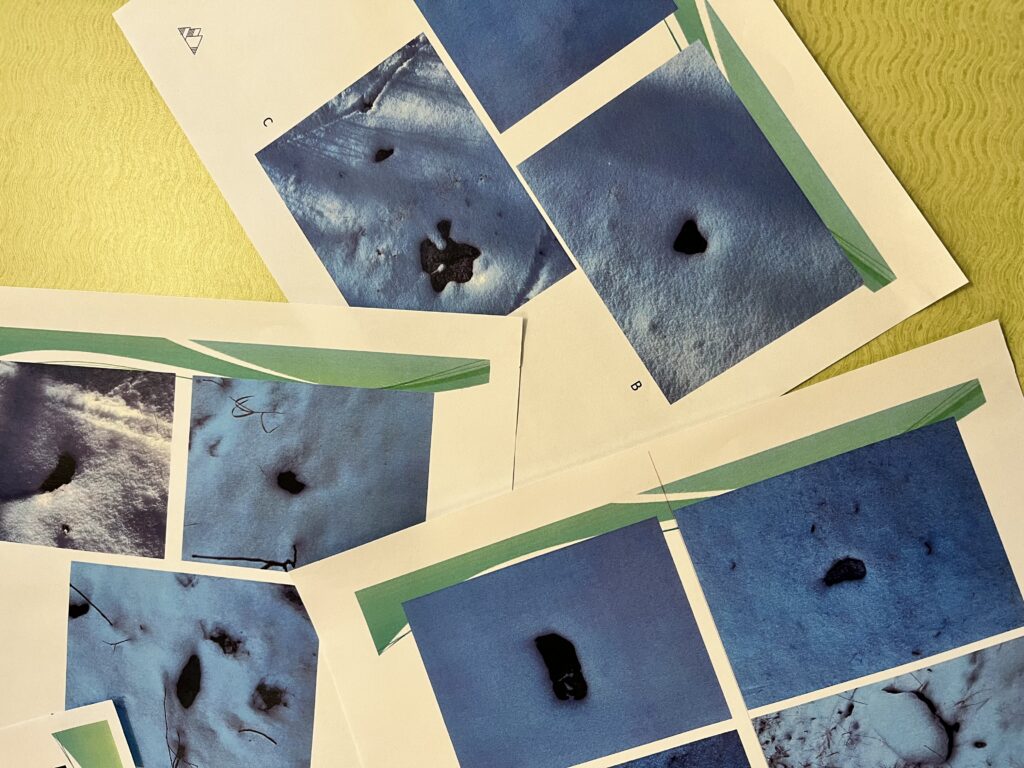
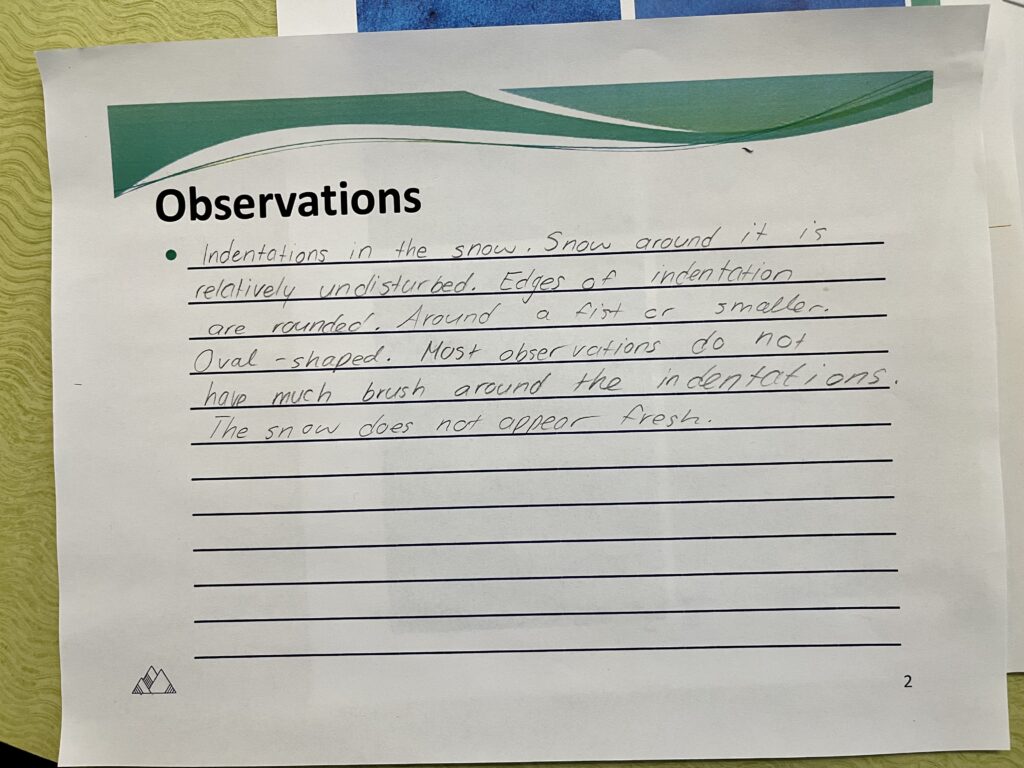
First observe a phenomenon. In our example we looked at pictures of rocks in snow. In this first step we were to record only what we saw and not make any conclusions at this point.Ā 

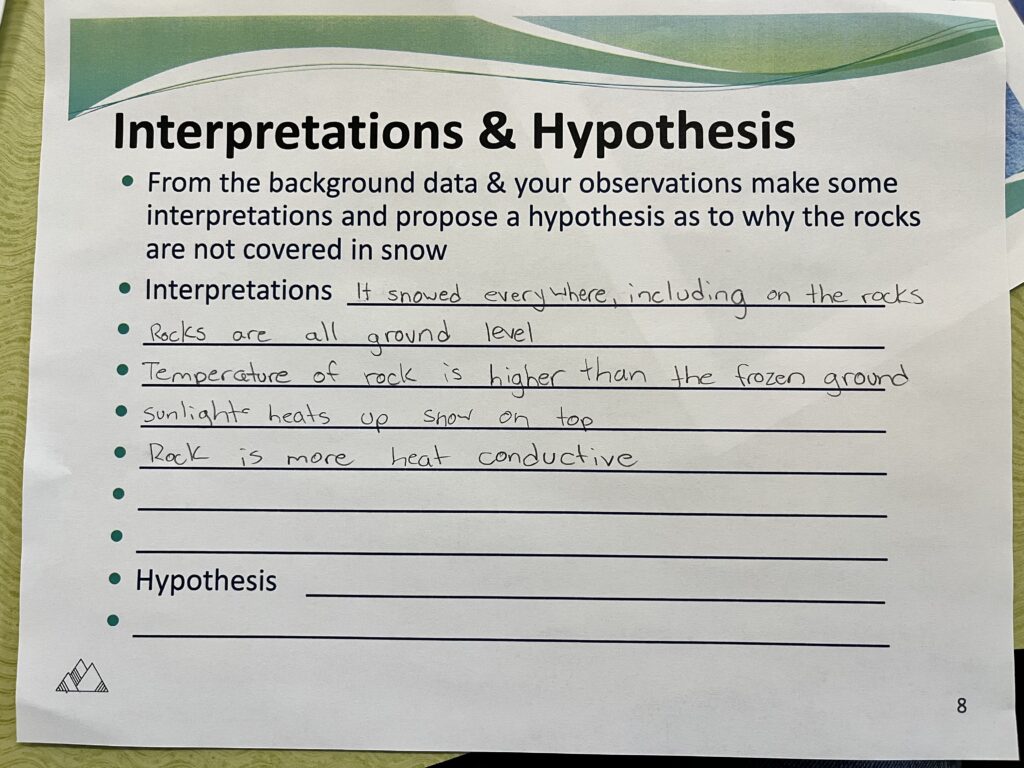
Next, we were to start interpreting our observations and putting the ā€œpuzzleā€ together.Ā 

Finally, in the hypothesis stage we were to suggest a reason for why this event was happening. This is the stage where an inquiry project with the phrase, ā€œyour ideas are really thought provoking, we are going to do some research to find out what is happening.ā€Ā 

Beyond Ecophobia

I don’t think that I am alone in feeling like environmentalism has felt so daunting and hopeless that it is hard to know where to begin. I care so deeply about Creation, yet feel so powerless to contribute anything truly meaningful. I make my efforts: planting a garden, composting, and conserving water; but what does that even matter when the big polluters of the world pour toxins into the atmosphere? I’m just one person. How much of a difference can I really make? And how much mental energy can I afford in feeling guilty when there is a beautiful life to get on with?Ā 

I think I have fallen prey to ecophobia. I’ve been scared to the point of disassociation. I have consciously or subconsciously distanced myself from thinking about the state of the Planet and what the future holds. While I do think there is some wisdom in not becoming worried about things beyond your control, I also think there is some apathy that sets in.Ā 

Moving beyond echophobia, for me, requires us to step back and fall in love with the living world. Instead of becoming hostile towards it we simply need to spend time being in it.Ā 

In an educational setting this means taking our students outside. Planning activities that inspire empathy. For example, I loved the group that made bird wings for each child. They spent time being in the woods like birds: making nests and painting their wings to look like the birds they saw. This activity sparked the children’s natural curiosity to find out more about the birds: what did they eat, what did they need to survive, and how can I help? This activity is good for the primary years.

Other age appropriate activities for the intermediate years could be making maps of the local area around each child’s home, school, and community. Additionally, fort building outside in nature is very beneficial to connecting to the land at this age. Or perhaps exploring a creek to study the water cycle: “Wet sneakers and muddy clothes are prerequisites for understanding the water cycle” (Beyond Ecophobia, David Sobel, 1993).

Once children reach adolescence, around age 12-15, they are ready to start thinking beyond their own small world and expand their love of nature and the Earth. This is the stage where social action becomes appropriate.

Introducing environmentalism at age appropriate stages, and not all at once is important to stave off the feeling of despair that causes us to distance ourselves from the source of that worry. Let us move slowly and with love and patience to inspire our students and ourselves toward more.

Read Alouds for all Readers

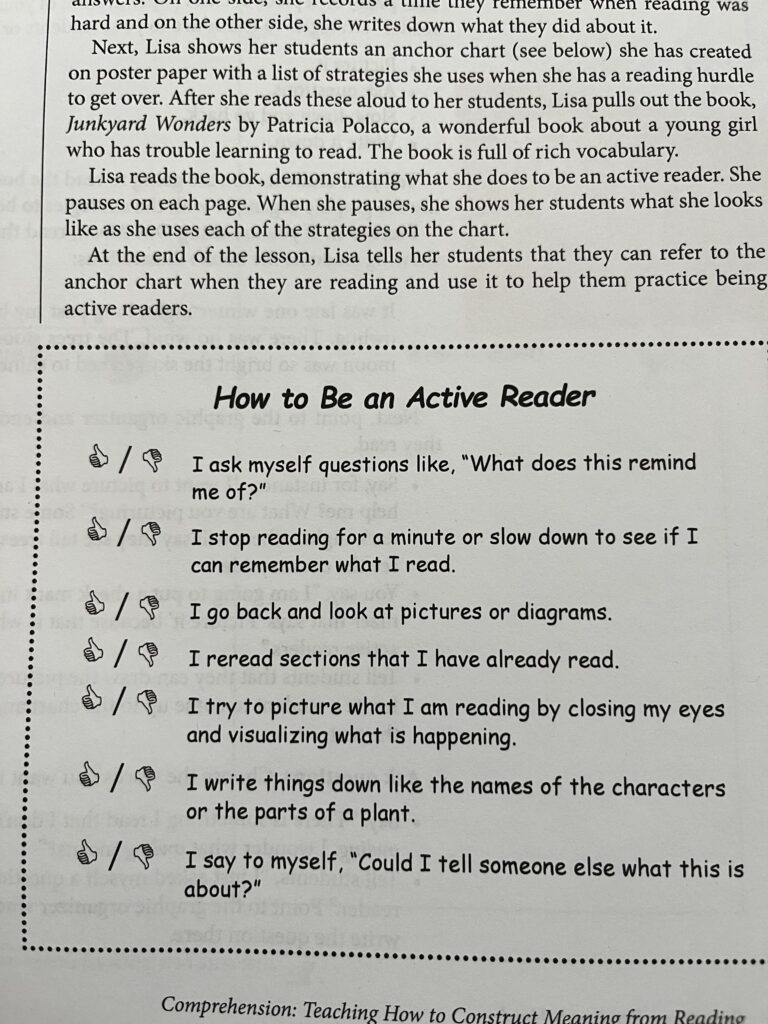
Read Alouds for all Readers by Molly Ness promotes the importance of reading aloud to ones class, regardless of age. Ness offers steps to create a “Read Aloud” (found below).

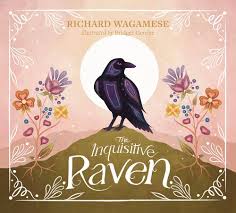
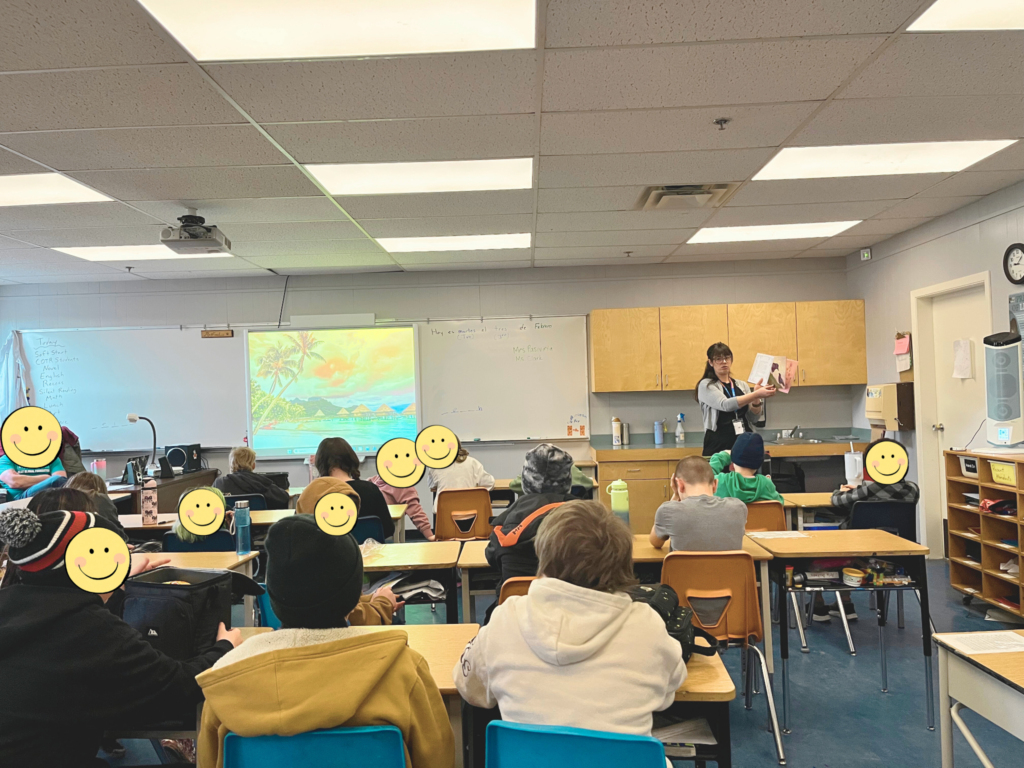
My partner and I read “The Inquisitive Raven” by Richard Wagamese, an Ojibwe author, to a grade 5 class. The book describes how Rueben’s inquisitiveness leads him to learn a very important lesson.

For this activity I considered Indigenous Perspectives and First Peoples Principles of Learning.

Learning involves generational roles and responsibilities; and learning involves recognizing the consequences of one’s actions. Rueben learned from his actions how important his role within the community is, and that all creatures have respect for one another.

This book also embodies the different roles family members have in raising youth.

Read Aloud Template

We did our read aloud activity over three days.

Day One: We read from page 1 to page 7.

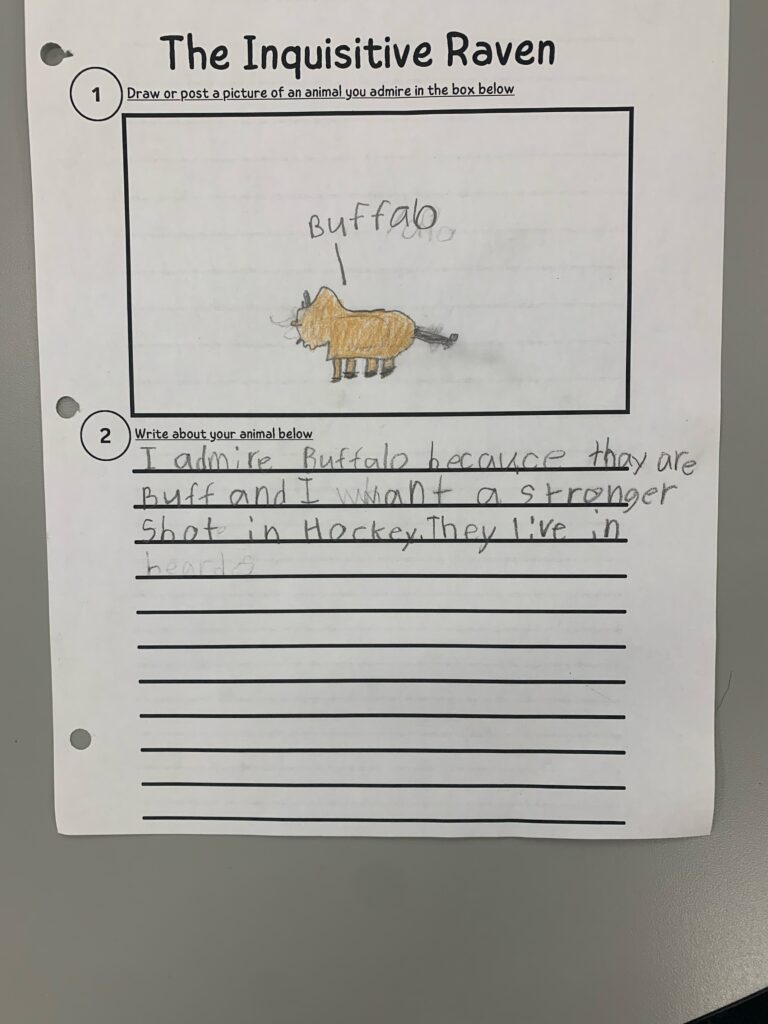
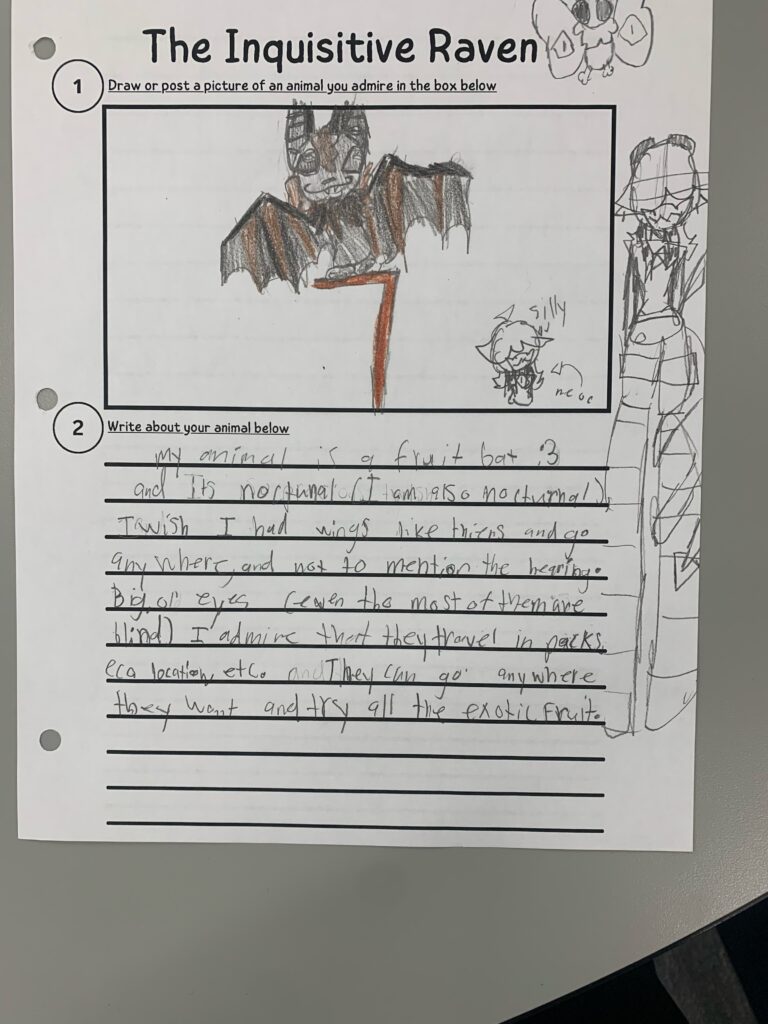
We had a little more time this day to do a drawing and writing activity. We brought books from the library with tons of different mammals, birds, fish, insects, and lizards. Students were asked to pick an animal they admire and draw it. There were a few students who went really in depth with their drawings, adding a lot of details and showing their admirable qualities. Others were a little silly, but for the most part they engaged really well. The second part of the activity had the students writing two-four sentences about what they admire about their animal. Many students filled up the rest of the page and had a lot to say about what made their animals special.

Day Two: We read from page 8 to page 23.

This day the book section was substantially longer. I would even say it was a tad too long. Some students were starting to get fidgety near the end, and I could hear little side conversations as my partner read.

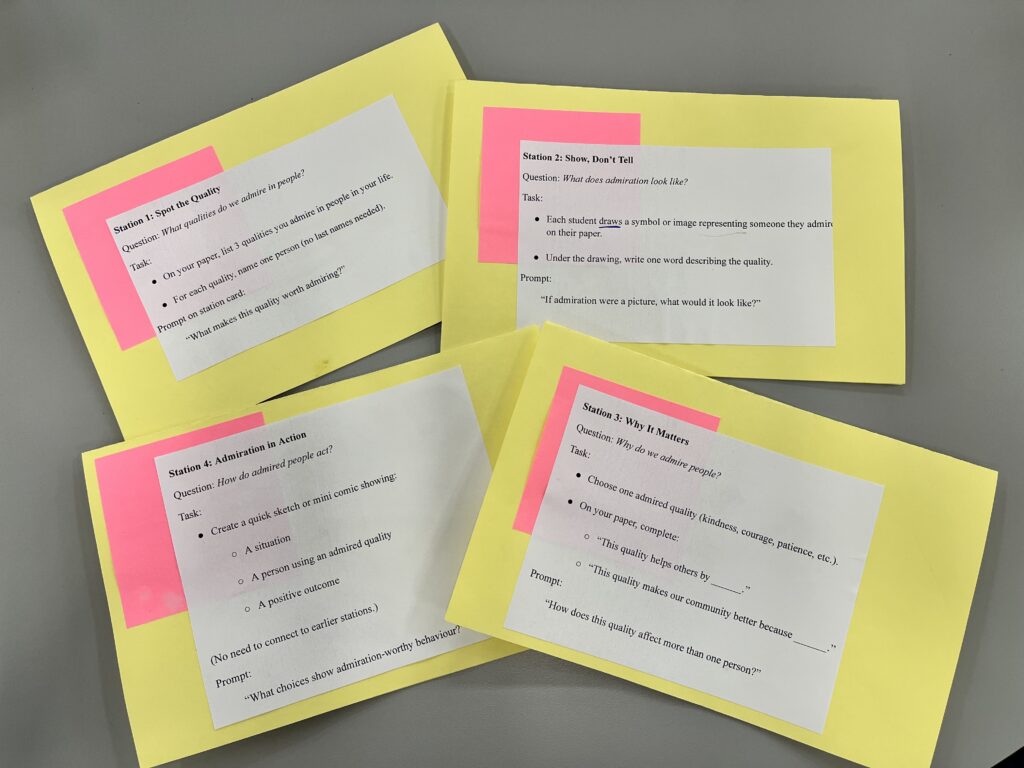
For the activity we made station cards. Students were given a blank piece of paper to use throughout the stations. In the future I would make the stations clearer on the paper.

Station 1: What qualities do we admire in people? List 3 qualities.

Station 2: What does admiration look like? Draw a symbol to represent something you admire.

Station 3: How can admiration influence us? Finish the sentences: “I admire people who_____?” “I could practice this by_____?”

Station 4: Why do we admire people? Finish the sentences: “This quality helps others by_____.” “This quality makes our community better because_____?”

Day Three: We read from page 24 to page to the end.

For this activity we did a mini lesson on making a tableau. We had one volunteer come up and my partner and I, along with our student volunteer created a tableau that the rest of the class had to guess. Next, we split the class into groups of 3 (one group of 4 girls and one group of 2 boys). Each group was given a scene from the book. The groups took turns presenting their tableaux for the class, and we all had to guess which scene it was. Following that we handed out admirable traits for each group to come up with their own ideas for how to display that trait. Some of the ideas were really wonderful. This day was by far the best as everyone stayed engaged and very little redirection was needed.

BC Curriculum Connections

Activity 1 falls under the grade 5 English Language Arts Curricular Competency: Use a variety of comprehension strategies before, during, and after reading, listening, or viewing to guide inquiry and deepen understanding of text.

Activity 2 falls under the grade 5 English Language Arts Curricular Competency: Use personal experience and knowledge to connect to text and develop understanding of self, community, and world.

Activity 3 falls under the grade 5 Arts Curricular Competency: Interpret and communicate ideas using symbols and elements to express meaning through the arts.

References

Curriculum. (n.d.-a). https://curriculum.gov.bc.ca/

First peoples principles of learning. First Nations Education Steering Committee FNESC. (n.d.-a). https://www.fnesc.ca/first-peoples-principles-of-learning/

Wagamese, R., & George, B. (2025). The inquisitive Raven. D&M Kids.

Asters and Goldenrods: The Importance of Seeing Beauty in Science

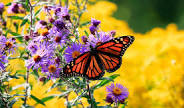
Asters and Goldenrods. Purple and gold. These colours are pleasing to us for a very good reason. These colours complement each other. As Robin Wall Kimmerer notices, in Braiding Sweetgrass: Indigenous Knowledge, Scientific Wisdom, and the Teaching of Plants, these flowers do not need to be pleasing to humans for survival. So why do they bother, scientifically speaking? It just so happens, Kimmerer explains, that what is beautiful to us two legged creatures, is also pleasing to the winged pollinators.Ā 

This got me to thinking that just because I cannot explain something scientifically, whether that is because I lack the knowledge or because it has not been discovered yet, does not mean that the thing in question is to be discounted. For me this is profound as a teacher. While I want to teach my students the information that is in the Curriculum, I also want them to understand that the Western perspective is lacking. There is profound beauty in other ways of understanding.

In our science demonstrations I noticed just how beautiful food colouring is in cold water. A spreading orb of colour suspended in liquid, spreading as if in slow motion. There is of course a scientific explanation for this. However, that explanation does not discount the moment of peace and joy I felt at seeing that. I did not feel those things because I understood the molecules were moving slowly and were therefore not spreading the colour around as quickly as the hot water in the neighbouring container. No. It was a simple moment of observed beauty. If I can teach that to my students, that everything is connected, science-art-regulation-math-love-the whole world, then I will be a part of something truly beautiful. 

Some tools I picked up that I do not want to forget are:

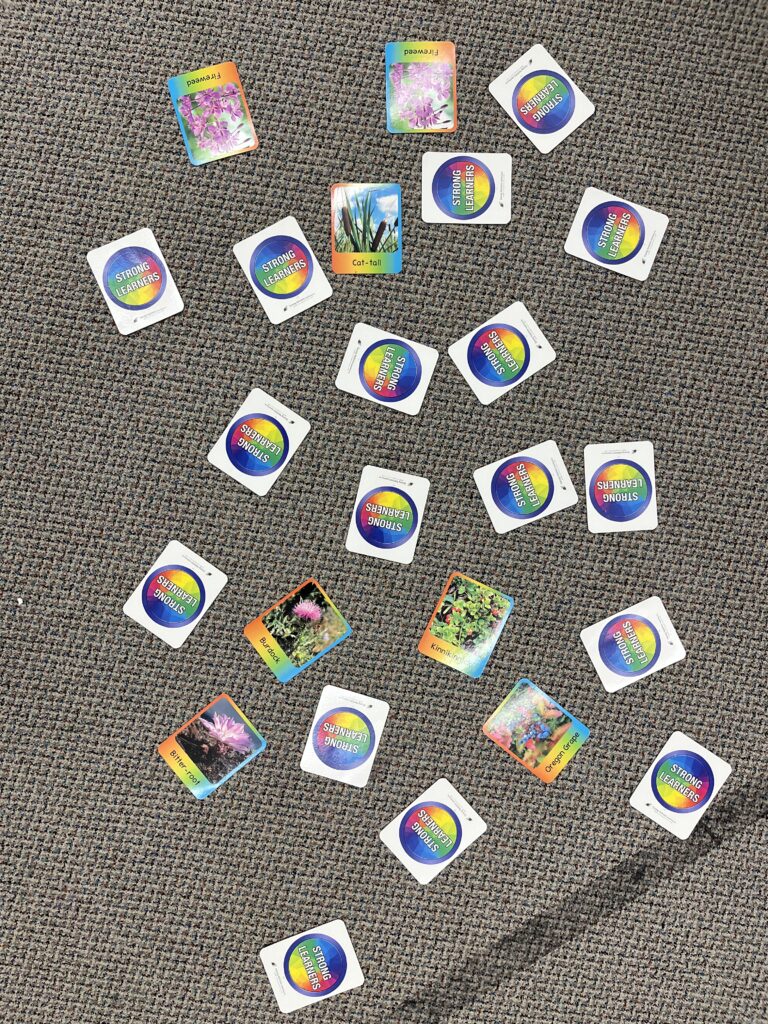
Using this matching game to learn local plants paired with the First Voices app to learn the names in Ktunaxa. In order to make the game go faster, leave the cards face up so kids can find a match easier. 

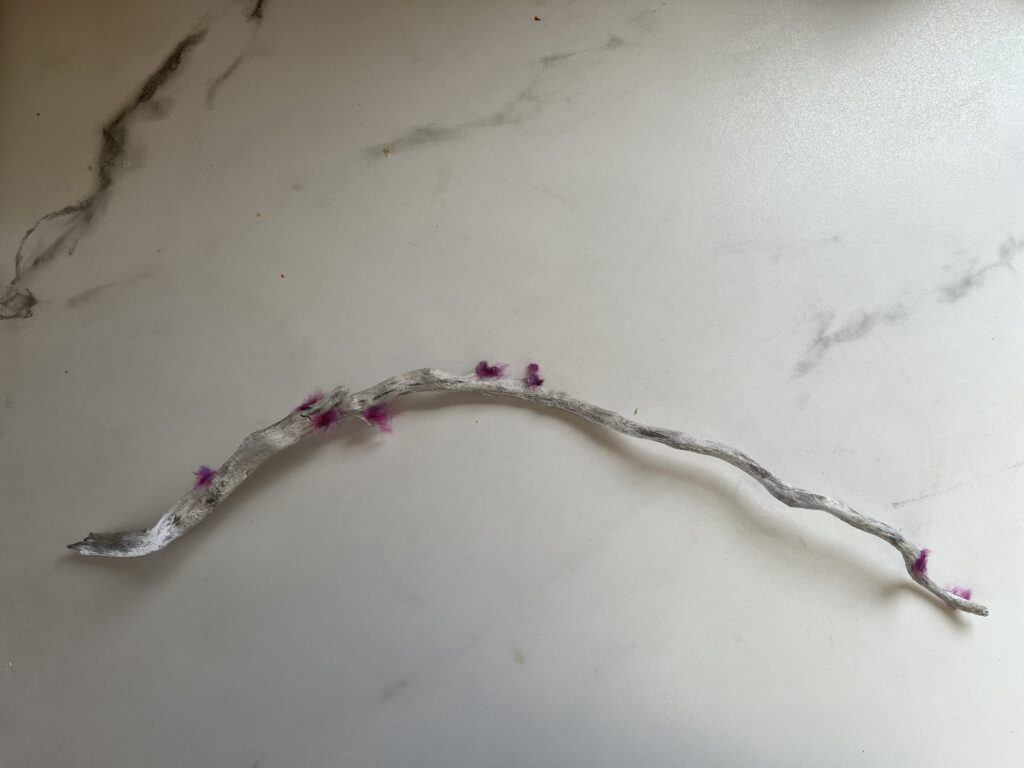
Also a great cross-curricular activity is to collect sticks and have the students make up a new plant. Have them write the name, how they found it, and what it is used for. 

To Hypothesize or Not to Hypothesize, that is the Question.

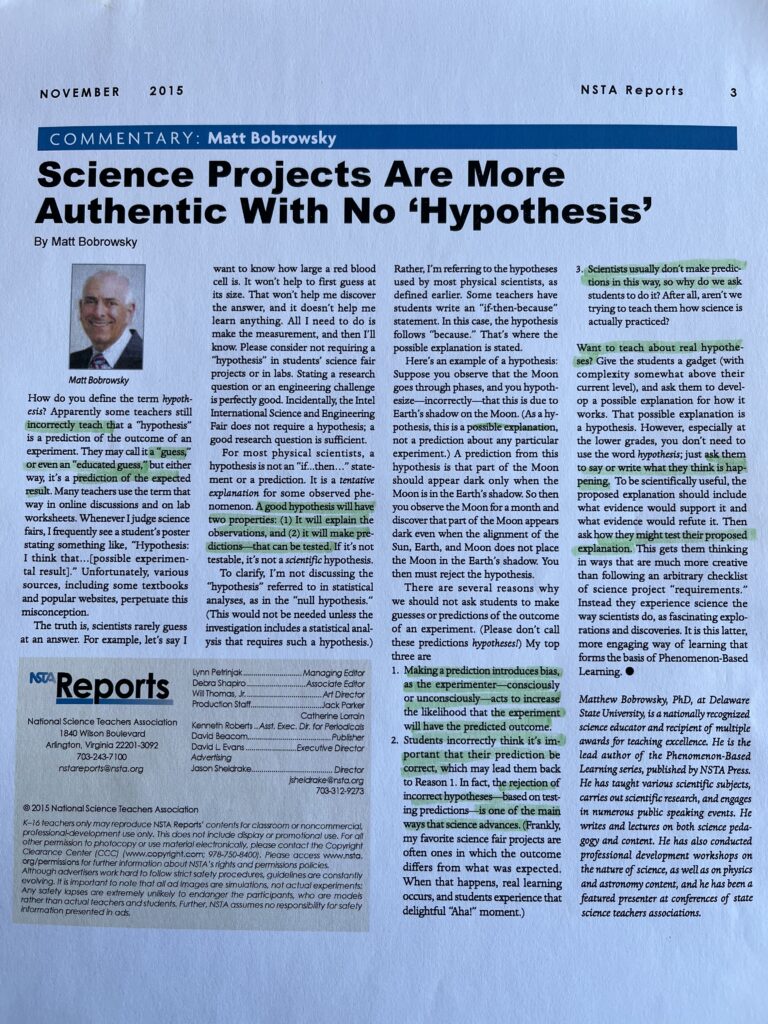
I grew up in a time, and I think many of us have, when we got ready for our school science fair every year. We would each come up with an hypothesis. We would employ the scientific method, create our tri-fold poster, and present. Job well done. But what about if we challenged the traditional science fair hypothesis tradition, and embraced instead what Matt Bobrowsky argues, that ā€œscience projects are more authentic with no ā€˜hypothesisā€™ā€ (Bobrowsky, 2015)? I wonder how I can foster a love of learning and questioning without buying in to the old traditional ways of “doing the science fair”?

One way is to use the POE method: Predict, Observe, Explain. In this method students do not skew their results to fit what their hypothesis is, and engage in real learning to explain what they observe. This becomes a celebration of learning instead of a box to tick.

I wonder if this kind engagement will really prepare our students for the future and inspire new discovery.Ā 

I wonder how I might adapt the POE method for the early years and the intermediate-to-middle school years.

Observation

Coming from a liberal arts background the phrase ā€œscientific observationā€ was slightly intimidating. However, when I began to understand that scientific observation can take the form of a sweet child wandering around her yard looking for evidence of fairies I was heartened.Ā 

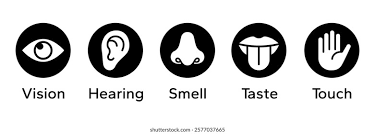
As an elementary teacher I can create activities that encourage my students to use all of their senses (maybe minus taste) to observe the world around them. 

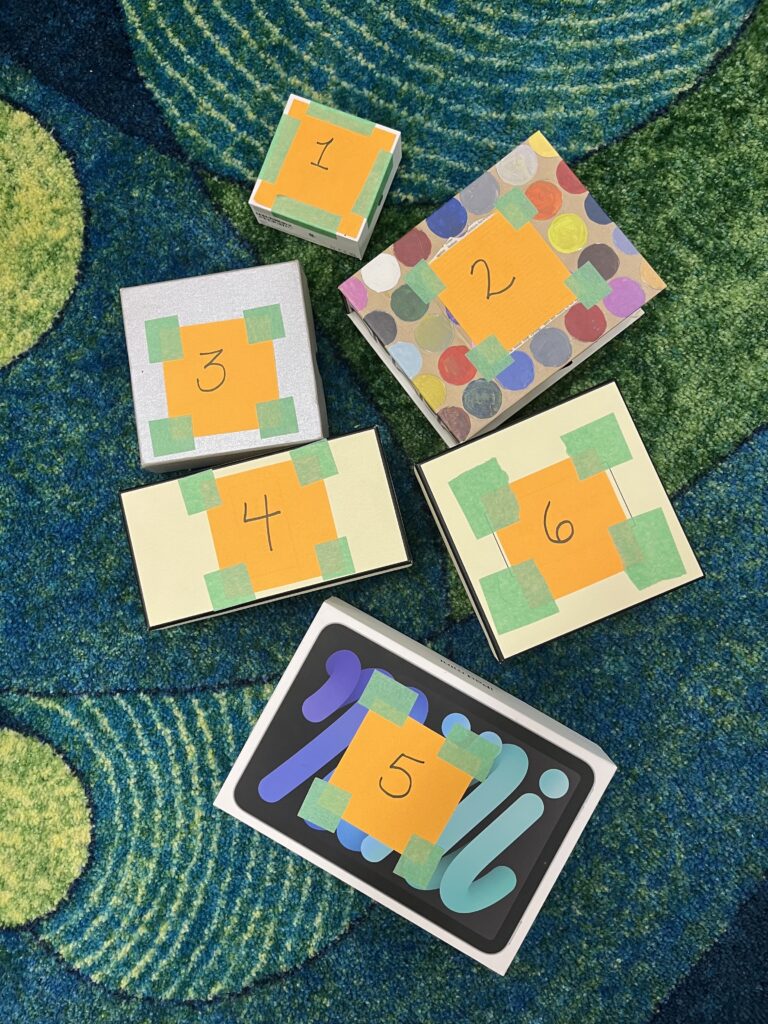
Here is an activity I learned in my Science Curriculum class that illustrates this exactly. To play, the teacher divides the class into 6 groups. Each group has a recording sheet and a numbered box. The group members use their senses to observe and predict what is inside the box. After each group has had each box the teacher reveals what is inside each box. This is a great game to play with all ages as I fully enjoyed it as an adult. 

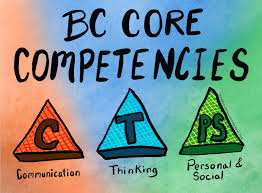
This game also engages the Core Competency of Critical and Reflective Thinking perfectly as students have to analyze and make judgements. Furthermore, they have to work as a team to make a singular prediction which touches on Social Awareness and Responsibility.Ā 

I still wonder how I can encourage curiosity and wonder, use Indigenous ways of approaching nature, and teach all that I need to teach in the Science Curriculum. Sometimes I feel like I am ill equipped. I imagine this is why we lean on one another as teachers, using ideas like those above, and become friendly thieves and generous givers.

« Older posts